




Is Geothermal Energy Good for the Environment? What the Science Shows
Geothermal energy harnesses heat from Earth’s interior to generate electricity and provide direct heating with significantly lower greenhouse gas emissions than fossil fuels, making it one of the cleanest baseload power sources available in 2026.
The environmental credentials of geothermal power extend beyond its minimal carbon footprint. Unlike intermittent renewables, geothermal plants operate continuously at 90-95% capacity factors, delivering reliable clean energy without requiring battery storage or backup generation. Modern geothermal facilities occupy a fraction of the land required by solar farms or wind installations per megawatt produced, and they release negligible air pollutants during operation.
But the technology presents environmental complexities that warrant careful examination. Enhanced geothermal systems can trigger minor seismic events in geologically sensitive areas. Water consumption varies dramatically across installation types, with binary-cycle plants using closed-loop systems that minimize withdrawals, while flash steam plants in water-scarce regions face legitimate sustainability questions. Some geothermal reservoirs release naturally occurring hydrogen sulfide and trace amounts of mercury, requiring emission controls. Land subsidence has occurred at certain high-extraction sites, though improved reservoir management has reduced this risk substantially.
This article evaluates geothermal energy’s environmental performance across six dimensions: atmospheric emissions, water resource impacts, land use efficiency, induced seismicity, thermal pollution, and lifecycle resource consumption. We’ll examine how different geothermal technologies compare environmentally, quantify benefits against conventional generation, and identify the conditions under which geothermal deployment delivers optimal environmental outcomes. The analysis draws on peer-reviewed research, operational data from commercial installations across Iceland, Kenya, Indonesia, and North America, and comparative assessments against solar, wind, nuclear, and natural gas alternatives.
What Geothermal Energy Means for Environmental Impact
Geothermal energy taps into heat stored beneath Earth’s surface, a resource continuously replenished by radioactive decay in the planet’s core and residual heat from its formation. From an environmental standpoint, this heat represents a fundamentally different energy source than combustible fuels: accessing it requires no burning, no chemical reactions that release carbon, and no depletion of finite reserves within human timescales.
The classification as renewable stems from Earth’s vast thermal reservoir and the rate at which heat regenerates. While individual geothermal reservoirs can experience temporary pressure or temperature declines if extraction exceeds natural recharge, proper management maintains productivity indefinitely. This contrasts sharply with fossil fuels, which form over millions of years but burn in seconds.
Understanding how geothermal is generated clarifies its low-carbon profile. Geothermal plants extract hot water or steam from underground reservoirs, use that heat to drive turbines or provide direct heating, then typically reinject cooled fluid back into the reservoir. This closed-loop approach minimizes atmospheric emissions and preserves the resource base.
- Geothermal gradient
- The rate at which temperature increases with depth below Earth’s surface, typically 25-30°C per kilometer. Higher gradients in tectonically active regions make geothermal extraction more economically and environmentally efficient.
- Closed-loop systems
- Geothermal configurations that reinject extracted fluids back into the reservoir after heat extraction. This design conserves water, maintains reservoir pressure, and prevents surface contamination.
- Baseload renewable
- Energy sources that provide consistent, uninterrupted power regardless of weather or time of day. Geothermal’s continuous availability reduces reliance on fossil fuel backup generation.
- Emission intensity
- The quantity of greenhouse gases released per unit of electricity generated, typically measured in grams of CO₂ equivalent per kilowatt-hour. Geothermal facilities register 10-20 times lower emission intensity than coal plants.
These baseline characteristics position geothermal as distinct from intermittent renewables like solar and wind, which require storage or backup, and from biomass, which involves combustion. The environmental advantages extend beyond zero fuel combustion to include minimal land disturbance and decades-long operational lifespans with stable performance.
How Geothermal Systems Interact with the Environment
The Geothermal Energy Cycle
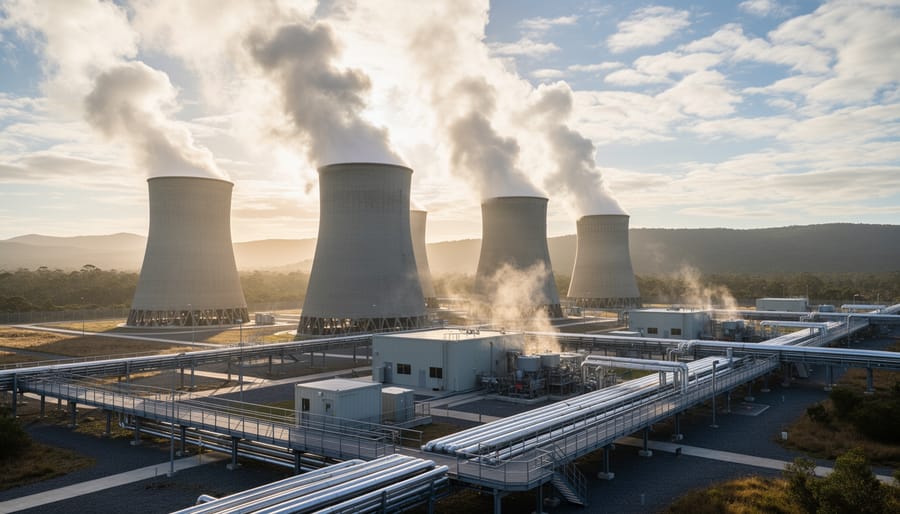
Geothermal plants extract heat from underground reservoirs through a closed-loop process that begins hundreds to thousands of meters below the surface. Operators drill production wells into fractured rock containing hot water or steam, which rises naturally or gets pumped to the surface under pressure. At the wellhead, this thermal fluid enters the power plant where its heat converts a secondary working fluid into steam (in binary plants) or drives turbines directly (in flash and dry steam plants).
After releasing its thermal energy, the cooled geothermal fluid faces a critical environmental decision point. Most modern facilities reinject this spent fluid back into the reservoir through separate injection wells, maintaining underground pressure and minimizing surface discharge. This closed-loop approach reduces water loss and prevents dissolved minerals from reaching surface waters. However, reinjection introduces potential environmental interactions, the cooled water can alter subsurface temperatures, change formation pressures, and in some cases trigger minor seismic activity.
Plants using direct discharge instead send cooled fluid to surface water bodies or evaporation ponds, where elevated temperatures and dissolved minerals like arsenic or boron can affect local ecosystems. The production wells themselves penetrate multiple geological layers, creating pathways where careful well construction and cementing become essential to prevent cross-contamination between aquifers. Each stage presents specific environmental contact points requiring active management.
Resource Characteristics and Sustainability
Geothermal reservoirs function as finite but renewable resources when extraction rates align with natural heat recharge. Underground heat replenishes continuously from Earth’s core, but the timeframe matters: shallow reservoirs may recover heat within years, while deep systems can take decades or longer. Sustainable management requires extracting heat slower than geological processes restore it.
Pressure maintenance proves critical for environmental stability. Operators monitor reservoir pressure through reinjection, pumping used water back underground, which prevents subsidence, maintains fracture networks, and extends productive lifespan. When extraction outpaces reinjection, pressure declines can trigger ground settling, alter local hydrology, and diminish output.
The sustainable extraction ceiling varies by site geology. Iceland’s Hellisheiði plant reduced steam extraction after pressure drops signaled over-production, demonstrating adaptive management. Conversely, The Geysers in California experienced significant depletion before implementing large-scale water reinjection programs that stabilized the field. Continuous reservoir modeling and monitoring determine whether a geothermal operation maintains environmental equilibrium or degrades its resource base over time.
Environmental Categories of Geothermal Technology
Geothermal installations operate through distinct technological configurations, each producing measurably different environmental impacts. Understanding these variations helps assess geothermal energy’s overall environmental profile and identify deployment strategies that minimize ecological disruption.
Binary cycle plants represent the cleanest operational category. These closed-loop systems circulate a secondary working fluid with a low boiling point through a heat exchanger, allowing geothermal water to remain underground after transferring thermal energy. Binary plants emit virtually no greenhouse gases during operation because geothermal fluids never contact the atmosphere. Water consumption remains minimal since most systems reinject 100% of extracted water. Their primary environmental advantage lies in compatibility with lower-temperature resources (90-175°C), enabling development in regions where conventional geothermal extraction proves impractical.
Flash steam facilities dominate established geothermal markets but carry higher environmental loads. These plants allow pressurized geothermal water to “flash” into steam when pressure drops, driving turbines before condensing and reinjection. Flash plants release non-condensable gases, primarily carbon dioxide and hydrogen sulfide, that were dissolved in subsurface water. Typical emissions range from 27 to 122 kg CO₂ per megawatt-hour, substantially below fossil generation but higher than binary systems. Water losses occur during cooling, though modern designs reinject most fluids to maintain reservoir pressure.
Dry steam plantsthe rarest category, extract pure steam directly from underground reservoirs. The Geysers in California exemplifies this technology type. Environmental impacts mirror flash systems but with slightly higher gas emissions per unit since steam concentrates dissolved gases. However, their efficiency offsets this through higher power output per well.
Enhanced Geothermal Systems introduce controlled fracturing to create permeability in hot dry rock, expanding accessible resources. EGS carries unique environmental considerations: induced seismicity from hydraulic stimulation, though typically minor; higher water requirements during development phases; and potential subsurface fluid migration. Current pilot projects monitor these impacts closely, with seismic activity rarely exceeding magnitudes detectable without instruments.
Direct-use applicationsdistrict heating, greenhouse warming, aquaculture, bypass electricity generation entirely. These systems circulate geothermal fluids through heat exchangers for thermal applications, producing negligible emissions and modest water consumption. Their environmental footprint remains proportional to extraction scale, generally lighter than power generation due to lower temperature requirements and shallower drilling depths.
Key Environmental Benefits
Carbon Emissions and Climate Impact
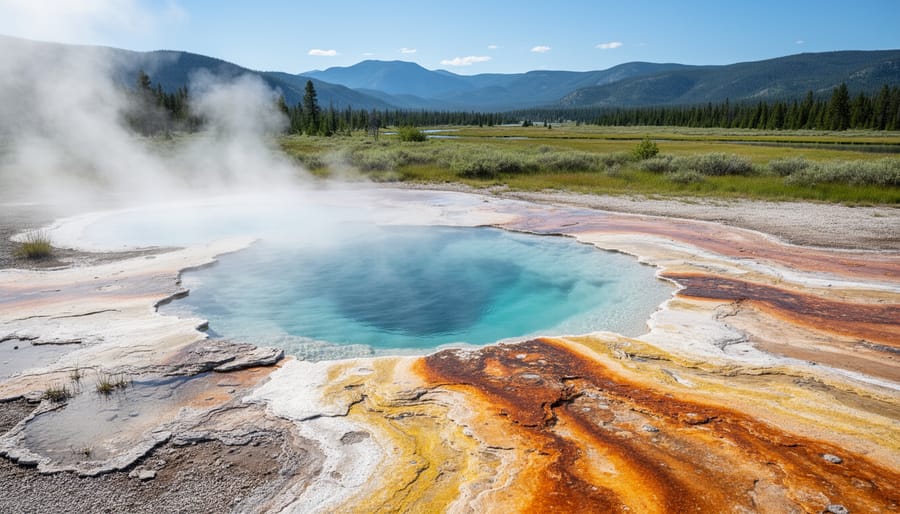
Geothermal power plants emit remarkably little carbon dioxide during operation, typically between 30 and 75 grams of CO₂ per kilowatt-hour generated, according to lifecycle assessments conducted across multiple facilities. This stands in sharp contrast to coal plants, which release approximately 820 grams per kWh, and natural gas combined-cycle plants at around 490 grams per kWh. Even when accounting for construction, drilling, and plant decommissioning, geothermal’s lifecycle emissions remain 85-95% lower than fossil fuel alternatives.
Binary cycle plants, which use closed-loop systems, produce the lowest emissions, often under 20 grams per kWh, since they release virtually no reservoir fluids to the atmosphere. Flash steam and dry steam facilities emit more CO₂ because they vent gases dissolved in the geothermal fluid, but these emissions still represent carbon that was already present in underground reservoirs rather than new atmospheric additions from combustion.
Some geothermal reservoirs contain non-CO₂ gases, particularly hydrogen sulfide and methane in trace amounts. Modern plants capture hydrogen sulfide through chemical scrubbing systems, converting it to elemental sulfur. Methane emissions, where present, remain negligible compared to natural gas extraction and coal mining operations. Overall, geothermal energy ranks among the lowest-carbon electricity sources available, comparable to wind and nuclear power.
Land Use Efficiency
Geothermal power plants occupy significantly less land per unit of energy generated than most renewable alternatives. A typical geothermal facility requires approximately 1-8 square kilometers per gigawatt of capacity over its operational lifetime, compared to 32-116 square kilometers for solar photovoltaic arrays and 180-280 square kilometers for wind farms. This translates to power densities often exceeding 10 watts per square meter for geothermal installations, whereas solar arrays average 4-9 watts per square meter and wind facilities 1-2 watts per square meter.
The compact footprint minimizes habitat fragmentation and allows geothermal development in areas where large-scale solar or wind deployment would displace wildlife corridors or agricultural land. Binary cycle plants, which recirculate fluids in closed loops, further reduce surface disturbance by eliminating the need for cooling ponds or extensive piping networks. Drilling pads can be consolidated, and once operational, facilities require minimal ground-level infrastructure beyond wellheads and compact generating buildings, leaving surrounding landscapes relatively undisturbed.
Baseload Reliability and Grid Stability
Geothermal plants operate continuously at stable output levels, typically achieving capacity factors above 90%, far exceeding solar (15-25%) and wind (25-45%). This consistency eliminates the need for fossil fuel “peaker” plants that traditionally compensate for renewable intermittency. When grid operators can rely on predictable geothermal generation, they avoid cycling coal or natural gas facilities on and off to match demand fluctuations, a practice that produces disproportionately high emissions due to inefficient start-up cycles.
The environmental benefit compounds across the entire electricity system. A 100 MW geothermal facility displaces not just its own generation from fossil sources but also reduces the standby capacity required to balance variable renewables. In Iceland, where geothermal provides 25% of electricity, grid operators maintain minimal fossil backup infrastructure. Similarly, California’s Geysers complex enables higher penetration of solar and wind by providing the stable foundation those intermittent sources require, driving systemic emissions reductions beyond the geothermal plants’ direct output.
Environmental Challenges and Trade-offs
Water Resource Implications
Geothermal facilities interact with water resources through three primary pathways: consumption in cooling systems, extraction from geothermal reservoirs, and potential aquifer impacts from drilling operations.
Binary cycle plants, the most common modern design, consume 720 to 4,000 gallons of water per megawatt-hour for cooling towers, comparable to natural gas plants but higher than wind or solar. Flash steam systems typically consume less because they use the geothermal fluid itself, though this depletes the reservoir if not reinjected.
Aquifer depletion presents real risks in regions where geothermal production exceeds natural recharge rates. The Geysers field in California experienced significant pressure decline until injection programs restored sustainability. Without careful monitoring, extraction can lower water tables, affecting agricultural wells and ecosystems dependent on groundwater.
Contamination concerns center on drilling fluids, accidental wellbore leaks, and improper disposal of geothermal brine containing dissolved salts, heavy metals, and arsenic. Modern closed-loop systems with complete reinjection minimize these risks, but legacy facilities and exploration drilling continue to pose localized threats, particularly in watersheds serving irrigation or municipal supplies.
Induced Seismicity Concerns
Geothermal operations can trigger minor seismic events through two primary mechanisms: fluid injection that increases pore pressure in rock formations, and thermal contraction as heat extraction cools surrounding rock. Enhanced Geothermal Systems present the highest risk because they deliberately fracture rock to create permeability, a process that can activate existing faults or create new fracture networks.
Most geothermal-induced earthquakes measure below magnitude 3.0, rarely perceptible at the surface. However, several EGS projects have recorded events between magnitude 3.0 and 4.0, causing public concern and operational suspensions. A 2017 project in Pohang, South Korea, was linked to a magnitude 5.5 earthquake, though researchers debate whether geothermal injection was the sole cause or amplified existing tectonic stress.
Modern risk management includes detailed subsurface mapping before drilling, real-time seismic monitoring networks, and traffic light protocols that reduce or halt injection when seismic activity exceeds predetermined thresholds. Operators increasingly employ adaptive stimulation techniques that minimize pressure buildup. While seismic risk can be managed, it requires continuous monitoring and cannot be entirely eliminated, particularly in tectonically active regions where geothermal resources are most abundant.
Local Air and Water Quality Effects
Geothermal plants release trace gases that can affect local air quality, though emissions remain far lower than fossil fuel combustion. Hydrogen sulfide (H₂S) poses the primary concern, a naturally occurring gas in geothermal reservoirs that smells like rotten eggs and becomes toxic at high concentrations. Modern binary cycle plants eliminate this issue by operating in closed loops, while flash and dry steam facilities typically emit 0.1-1 pound of H₂S per megawatt-hour compared to negligible amounts from wind or solar.
Thermal pollution affects water bodies receiving geothermal discharge. Plants reject waste heat into surface water or through cooling towers, potentially raising downstream temperatures by 2-5°C and disrupting aquatic ecosystems. Most facilities now use closed-loop cooling or reinjection to minimize thermal impacts.
Dissolved minerals in geothermal fluids, including arsenic, boron, and mercury, require treatment before discharge. Concentrations vary by reservoir chemistry; some sites show arsenic levels exceeding 5 mg/L. Modern plants employ filtration, precipitation, and reinjection protocols to prevent groundwater contamination, though older facilities occasionally exceed local water quality standards.
Real-World Applications and Environmental Performance
Global deployment of geothermal energy demonstrates measurable environmental performance across diverse settings. Iceland derives over 25% of its electricity and 90% of its heating from geothermal resources, achieving one of the world’s lowest per-capita carbon footprints for energy consumption. The country’s 2026 geothermal updates show continued expansion without proportional increases in land use or emissions intensity.
Kenya has emerged as Africa’s geothermal leader, with the Olkaria complex generating 863 MW while occupying less than 30 square kilometers. Field studies confirm minimal impact on surrounding wildlife corridors, and reinjection protocols have stabilized reservoir pressure without measurable subsidence. The Philippines operates 1,928 MW of geothermal capacity that avoids approximately 8.4 million tonnes of CO₂ annually compared to coal-fired alternatives.
Geothermal energy supports multiple environmental priorities across applications:
- Electricity generation with 24/7 baseload capacity and capacity factors above 90%
- District heating systems delivering low-carbon thermal energy in urban areas
- Industrial process heat replacing fossil fuel boilers in manufacturing
- Agricultural applications including greenhouse heating and aquaculture operations
- Hybrid renewable systems pairing geothermal with solar or wind for grid stability
In the United States, The Geysers field in California has operated for over 60 years with evolving environmental management. Early operations caused local air quality concerns from hydrogen sulfide, but modern abatement systems capture 99.9% of these emissions. Water recycling programs inject treated wastewater from nearby municipalities, addressing both reservoir sustainability and regional water management.
Corporate adoption reflects environmental performance verification. Major tech companies now integrate geothermal into corporate sustainability strategies, with Google and Meta funding next-generation projects. These partnerships accelerate deployment while establishing transparent monitoring protocols that document real-world environmental outcomes and refine best practices for emerging geothermal regions.
Comparative Environmental Assessment

Evaluating geothermal energy alongside other renewables requires examining quantifiable environmental metrics across the entire lifecycle, from material extraction to decommissioning. Carbon intensity provides the clearest comparative advantage: geothermal plants emit 6-79 grams of CO₂ equivalent per kilowatt-hour, depending on reservoir chemistry and technology type. This range sits below biomass (230-350 g CO₂e/kWh) and fossil fuels (coal at 820 g, natural gas at 490 g), while clustering near wind (11 g) and solar PV (41 g for utility-scale installations). Hydropower’s 24 g average masks wide variability tied to reservoir methane emissions in tropical regions.
Water consumption patterns reveal sharper contrasts. Flash steam and dry steam geothermal systems consume negligible water when using closed-loop reinjection, while binary cycle plants in water-cooled configurations use 1,400-1,800 liters per megawatt-hour. Solar PV requires 26-56 liters per MWh primarily for panel cleaning, and wind uses 4 liters. Hydropower evaporates 17,000 liters per MWh from reservoir surfaces in arid climates, and coal with cooling towers demands 2,000 liters.
Land transformation metrics favor geothermal’s compact footprint. A geothermal facility occupies 1-8 square kilometers per gigawatt of capacity, compared to solar’s 45-75 km² and wind’s 30-140 km² when accounting for turbine spacing. Material inputs tell another story: wind and solar require rare earth elements, steel, and silicon across distributed infrastructure, while geothermal concentrates material use in drilling equipment and wellhead machinery.
These comparisons gain rigor when based on transparent data and stricter editorial standards ensuring lifecycle assessments account for regional variations and technology-specific parameters rather than applying generalized averages.
Frequently Asked Questions
Is geothermal energy truly renewable or does it deplete the heat source?
Geothermal energy is renewable when managed properly because Earth’s core continuously generates heat through radioactive decay. Well-managed reservoirs with reinjection maintain pressure and temperature for decades, though extraction rates must remain within natural recharge capacity to ensure sustainability.
Can geothermal plants cause earthquakes?
Enhanced geothermal systems can trigger minor seismic events during drilling and fluid injection, though most are too small to feel. Conventional hydrothermal plants carry minimal seismic risk, and modern monitoring protocols help operators adjust injection parameters to reduce induced seismicity.
How does geothermal’s carbon footprint compare to solar and wind?
Geothermal plants emit 10-30 times less carbon per kilowatt-hour than coal plants and typically produce lower lifecycle emissions than solar panels when manufacturing impacts are included. Wind energy shows comparable emissions, while both technologies benefit from different deployment contexts within the broader energy transition context.
Does geothermal energy work in all climates?
High-temperature geothermal power generation requires specific geological conditions found along tectonic plate boundaries and volcanic zones, limiting geographic availability. However, low-temperature direct-use systems and ground-source heat pumps function effectively in nearly any climate for heating and cooling applications.
These questions reflect persistent concerns among energy professionals evaluating geothermal’s role in decarbonization strategies. The renewable classification centers on extraction rates matching natural heat replenishment, distinguishing sustainable operations from resource mining. Seismic concerns require context-specific assessment, as risk profiles vary substantially between enhanced systems requiring reservoir creation and conventional hydrothermal facilities tapping existing resources. Carbon comparisons must account for full lifecycle impacts, including equipment manufacturing and decommissioning, not just operational emissions. Geographic limitations shape deployment potential, though technological advances continue expanding viable applications beyond traditional high-enthalpy regions.
Geothermal energy delivers measurable environmental advantages that position it as a valuable component of clean energy transitions. The evidence shows lifecycle carbon emissions consistently ranking among the lowest of any power source, typically 4 to 6 percent of coal-fired generation and comparable to wind and nuclear. Its compact land footprint, often 400 square meters per gigawatt-hour, preserves habitat while delivering reliable baseload electricity that reduces dependence on fossil fuel backup generation.
These benefits matter for grid decarbonization. Unlike intermittent renewables, geothermal plants operate continuously at capacity factors exceeding 90 percent, providing stability that supports higher penetration of variable solar and wind resources. This characteristic makes geothermal particularly suited to regions with strong heat resources and ambitious emission reduction targets.
The technology’s environmental profile isn’t without complications. Water consumption in flash steam systems, induced seismicity risks in enhanced geothermal projects, and localized emissions of hydrogen sulfide require site-specific management protocols and regulatory oversight. Not every location is appropriate for development, and reservoir sustainability depends on extraction rates matching natural recharge.
Geothermal energy functions best as one element within diversified renewable portfolios rather than a universal solution. Where geological conditions align with demand centers and where operators implement rigorous environmental monitoring, it offers a low-carbon, space-efficient, and dependable electricity source. Continued advancement in closed-loop systems, improved drilling techniques, and seismic prediction models will further reduce environmental trade-offs. For energy systems prioritizing both decarbonization and reliability, geothermal warrants serious consideration alongside broader renewable deployment strategies.
