





Renewable Energy & Sustainability: How U.S. Corporations Are Navigating the Energy Transition
U.S. corporations are fundamentally restructuring their energy portfolios in response to converging regulatory mandates and market pressures. The Securities and Exchange Commission’s climate disclosure framework, fully implemented in 2026, now requires public companies to report Scope 1 and 2 emissions with third-party attestation. California’s climate accountability laws extend these requirements to private companies exceeding $500 million in annual revenue, creating compliance obligations for thousands of businesses previously exempt from federal reporting.
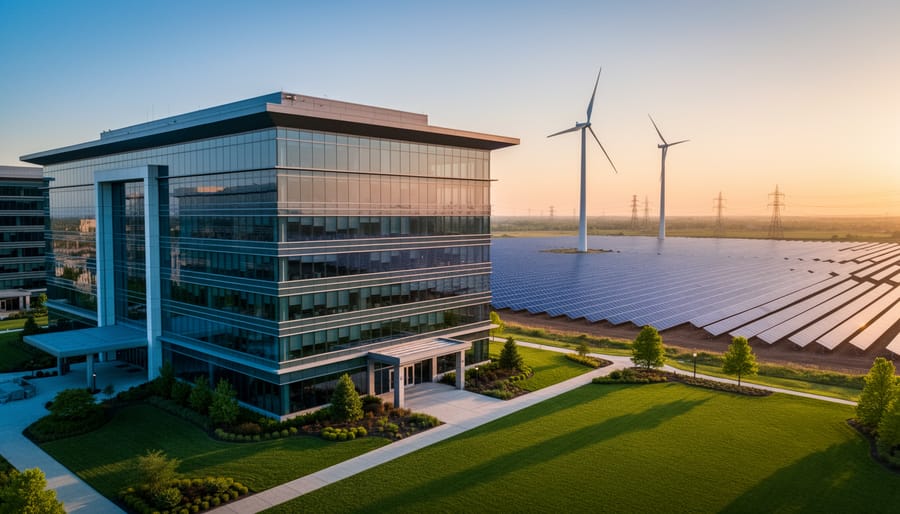
This regulatory environment has transformed renewable energy procurement from an optional sustainability gesture into a core financial consideration. Corporate power purchase agreements reached 15.2 gigawatts in 2025, representing direct investment in utility-scale solar and wind projects. Virtual PPAs allow companies without suitable roof space to claim renewable energy credits while hedging against electricity price volatility. Direct ownership models, meanwhile, provide the most comprehensive control over energy costs and emissions accounting, though they demand substantial capital deployment.
The business case extends beyond compliance. Forward-thinking corporations recognize that renewable energy integration directly affects supply chain resilience, investor relations, and competitive positioning. Companies reporting comprehensive sustainability metrics consistently demonstrate lower cost of capital and improved access to ESG-focused investment funds, which now control approximately $8.4 trillion in U.S. assets.
Implementation challenges remain significant. Grid interconnection queues average 3.7 years for new projects. Renewable energy certificates require careful verification to ensure additionality and avoid double-counting. Financial structuring of PPAs demands sophisticated analysis of basis risk, technology performance warranties, and merchant tail exposure.
This article examines the complete framework for corporate renewable energy transition, from regulatory compliance through strategic procurement and operational integration, providing actionable guidance for sustainability professionals navigating this complex landscape.
The State of Corporate Renewable Energy Adoption in 2026
U.S. corporations have reached a critical inflection point in renewable energy procurement, with 2026 marking a year when clean power transitions from peripheral sustainability initiatives to core operational strategy. The scale of corporate renewable energy adoption has accelerated dramatically, driven by converging economic, reputational, and regulatory pressures that make renewable procurement a business imperative rather than a voluntary commitment.
Cost competitiveness stands as the primary driver reshaping corporate energy strategies. Utility-scale solar and wind have become the cheapest sources of new electricity generation in most U.S. markets, fundamentally altering the financial calculus that once favored fossil fuel contracts. Corporations can now lock in long-term electricity prices below grid rates while simultaneously advancing sustainability objectives, turning renewable energy into a profit center rather than a cost burden. This economic reality has moved renewable procurement discussions from sustainability departments into CFO offices.
Investor pressure compounds these economic incentives. Institutional investors managing trillions in assets now systematically evaluate climate risk and energy transition preparedness when allocating capital. Companies demonstrating credible renewable energy strategies access lower costs of capital and attract ESG-focused investment flows, while those perceived as lagging face shareholder resolutions and divestment threats. Brand reputation amplifies these pressures in consumer-facing sectors, where sustainability commitments influence purchasing decisions and talent acquisition.
Technology and manufacturing sectors lead adoption rates in 2026, with data center operators particularly aggressive in securing renewable power to meet explosive electricity demands from AI infrastructure. Retail corporations with large physical footprints follow closely, leveraging rooftop solar and long-term power purchase agreements. Financial services and pharmaceutical companies have similarly expanded renewable procurement to meet stakeholder expectations and prepare for disclosure requirements.
The regulatory landscape, though still largely voluntary at the federal level, is tightening. California’s requirements for companies exceeding $1 billion in revenue doing business in the state create de facto national standards, as major corporations face Scope 1 and 2 emissions disclosures in 2026. This state-level action, combined with institutional investor demands, drives renewable procurement even absent comprehensive federal mandates. Corporations recognize that documenting verifiable renewable energy consumption provides the foundation for credible emissions reporting under emerging frameworks.
The Evolving U.S. Regulatory Landscape for Corporate Sustainability
Federal Framework and SEC Climate Disclosure Rules
The SEC’s climate disclosure journey began with a sweeping proposal in March 2022 that sought to standardize how publicly traded companies report climate-related risks and greenhouse gas emissions. After two years of industry feedback and revisions, the Commission finalized its climate-related disclosure rules in March 2024, though in a substantially narrower form than initially envisioned.
The final regulations required large accelerated and accelerated filers to disclose Scope 1 and Scope 2 greenhouse gas emissions. Scope 1 covers direct emissions from owned or controlled sources, while Scope 2 accounts for indirect emissions from purchased electricity, steam, heating, and cooling. These requirements represented a significant departure from the original proposal, notably excluding Scope 3 emissions, which encompass the full value chain from suppliers to end-use of products. The removal of Scope 3 disclosures eliminated what would have been the most comprehensive and challenging aspect of corporate climate reporting.
The regulatory landscape shifted again in March 2025 when the SEC withdrew its defense of these 2024 rules, effectively pausing their implementation. This withdrawal left the United States without comprehensive federal ESG reporting requirements, returning climate disclosure to its largely voluntary status as of 2026.
For corporations integrating renewable energy into sustainability strategies, this regulatory uncertainty creates a paradox. While federal mandates have stalled, investor pressure and stakeholder expectations continue driving disclosure practices. Many companies that built reporting infrastructure in anticipation of the SEC rules maintain those systems voluntarily, recognizing that transparency around energy sourcing and emissions reduction remains material to their market positioning regardless of regulatory enforcement.

California’s Pioneering State-Level Requirements
California has emerged as the regulatory vanguard, establishing the most comprehensive state-level climate disclosure requirements in the nation. Senate Bill 253, signed into law in October 2023, mandates that companies with annual revenues exceeding $1 billion doing business in California must publicly disclose their greenhouse gas emissions with independent assurance. The law’s phased timeline requires Scope 1 and Scope 2 emissions reporting beginning in 2026, followed by Scope 3 value chain emissions in 2027.
Unlike the withdrawn federal SEC rules, SB 253 specifically includes Scope 3 disclosures, capturing emissions from a company’s entire value chain, including purchased electricity and supplier activities. This requirement creates a direct financial incentive for corporations to accelerate renewable energy procurement. Companies that can demonstrate significant renewable energy adoption in their operations and supply chains will report lower emissions figures, potentially reducing regulatory risk and improving their competitive positioning with California-based customers and partners.
The law applies to thousands of U.S. corporations regardless of where they are headquartered, as long as they conduct business in California. This extraterritorial reach transforms a state regulation into a de facto national standard. Compliance costs and the public nature of assured emissions data are pushing affected companies to move renewable energy strategies from voluntary initiatives to core operational priorities, with power purchase agreements and on-site solar installations becoming central to emissions reduction plans rather than optional sustainability gestures.
The Voluntary Reporting Reality
Despite the SEC’s March 2024 climate disclosure regulations and subsequent March 2025 withdrawal of its defense, federal ESG reporting remains largely voluntary across the United States as of 2026. Outside California’s SB 253 requirements for companies exceeding $1 billion in revenue, most corporations face no binding mandate to report emissions or renewable energy procurement.
Yet voluntary disclosure has not translated to corporate inaction. Many large U.S. corporations continue publishing annual sustainability reports, setting science-based targets, and tracking renewable energy purchases through frameworks like CDP, GRI, and TCFD. Investor pressure, customer expectations, and supply chain demands create de facto reporting obligations even where legal requirements are absent. Companies operating globally also align U.S. operations with stricter European Union disclosure standards to maintain consistency.
This voluntary approach creates a fragmented landscape. Reporting quality varies widely, with some corporations providing granular renewable energy data while others offer vague commitments. The absence of standardized federal requirements means corporations self-select disclosure scope, often emphasizing favorable metrics while omitting challenging areas like Scope 3 emissions. This flexibility allows businesses to shape sustainability narratives but undermines comparability and accountability across the corporate sector.
Corporate Renewable Energy Strategies Driving Sustainability
On-Site Solar and Distributed Generation
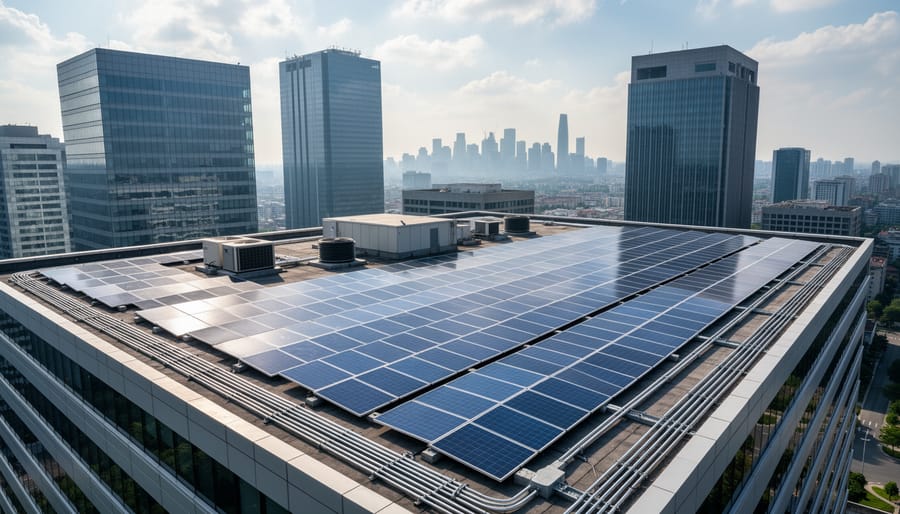
Corporations are increasingly turning to on-site solar installations as a tangible expression of their renewable energy commitments. Rooftop systems on warehouses, distribution centers, and office buildings represent the most common deployment model, particularly among retailers and logistics companies seeking to maximize underutilized space. A single large facility can accommodate multi-megawatt arrays that offset a substantial portion of daytime electricity consumption while reducing Scope 2 emissions from grid power.
Carport solar installations have emerged as a dual-purpose solution, providing both renewable generation and weather protection for employee and customer parking areas. These elevated structures typically yield higher per-square-foot generation than rooftop systems due to optimal panel orientation and reduced shading constraints. Technology manufacturers and healthcare systems have been particularly aggressive in deploying carport arrays at their campuses.
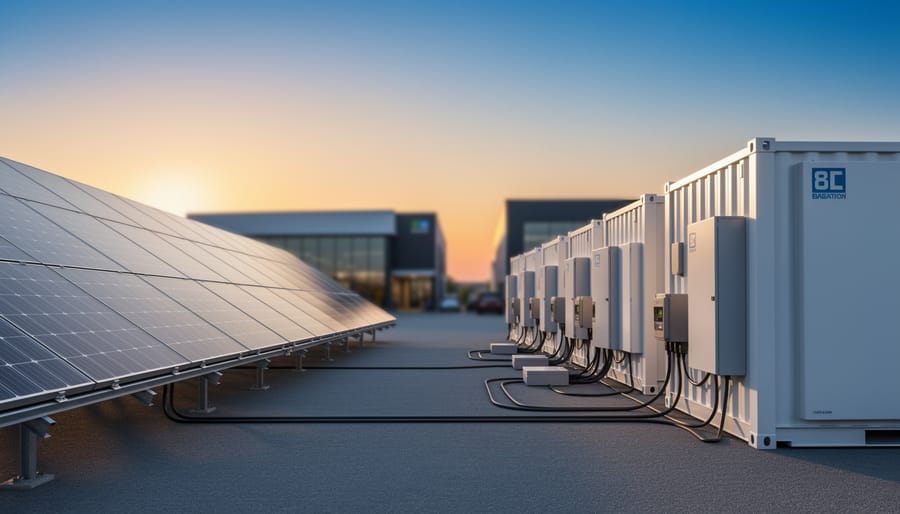
Facility-scale ground-mount projects allow corporations with available land to install utility-scale systems that can meet or exceed total site energy demand. Manufacturing facilities and data centers with significant acreage frequently pursue these installations, sometimes incorporating battery storage to shift generation output and improve demand charge management.
Financial considerations have shifted dramatically. Declining equipment costs, combined with federal investment tax credits and accelerated depreciation schedules, have pushed payback periods below seven years for many commercial installations. Corporations can finance projects through direct capital expenditure, power purchase agreements with third-party developers, or operating leases that minimize upfront investment while securing predictable energy costs.
Power Purchase Agreements and Virtual PPAs
Power purchase agreements have emerged as the dominant mechanism for corporations to secure renewable energy at scale without capital expenditure or land requirements. A physical PPA involves a direct contractual relationship where a corporation agrees to buy electricity from a specific renewable energy project, typically solar or wind, at a predetermined price over 10 to 25 years. The developer builds and operates the facility, while the corporate buyer receives both the electricity and the associated renewable energy certificates, ensuring additionality and a verifiable emissions reduction claim.
Virtual PPAs operate differently but have become increasingly popular for corporations with multi-state operations. Under a virtual PPA structure, the corporation doesn’t physically receive the electricity generated. Instead, the agreement functions as a financial hedge: the corporate buyer agrees to pay a fixed price per megawatt-hour, while the developer sells the power into the wholesale market at the prevailing rate. When market prices exceed the contract price, the developer pays the difference to the corporation; when market prices fall below, the corporation compensates the developer. This contract-for-difference model allows companies to support new renewable capacity regardless of where their facilities are located, though it requires sophisticated risk management and accounting.
Both structures lock in long-term energy costs, hedge against fossil fuel price volatility, and provide the project financing certainty that enables developers to secure construction capital. Major technology firms, retailers, and manufacturers have collectively signed gigawatts of PPAs since 2020, fundamentally reshaping corporate energy procurement from a purely transactional utility relationship into strategic portfolio management centered on price stability and decarbonization objectives.
Beyond Solar: Wind, Storage, and Emerging Technologies
While solar dominates corporate renewable portfolios, forward-thinking companies are diversifying with wind, storage, and next-generation technologies. Large corporations with distributed operations increasingly contract for wind energy through PPAs, particularly in states with strong wind resources like Texas and the Midwest. Battery storage systems have become essential complements to solar and wind investments, enabling corporations to store excess generation, participate in demand response programs, and maintain power resilience during grid disruptions.
Energy storage deployments allow companies to optimize renewable electricity consumption by shifting stored power to peak demand periods, reducing both costs and grid strain. Beyond conventional renewables, corporations are piloting green hydrogen production for industrial processes, investing in geothermal energy for baseload power, and exploring advanced nuclear technologies as potential carbon-free baseload alternatives. This technology diversification reduces portfolio risk, matches renewable generation profiles to specific operational needs, and positions corporations to capitalize on cost improvements across multiple clean energy pathways as the energy transition accelerates.
The Business Case for Corporate Renewable Energy Investment
The economic rationale for corporate renewable energy investment extends far beyond regulatory compliance or public relations gestures. In 2026, corporations are discovering that renewable energy procurement delivers measurable financial returns while simultaneously addressing strategic risks that traditional energy sourcing cannot mitigate. The confluence of falling technology costs, volatile fossil fuel markets, and stakeholder pressure has transformed renewable energy from an aspirational sustainability initiative into a core business imperative with quantifiable bottom-line impact.
Cost competitiveness stands as the most immediate driver of corporate renewable energy adoption. Utility-scale solar and wind projects now consistently undercut fossil fuel generation on a levelized cost basis across most U.S. markets, with industrial-scale power purchase agreements frequently delivering electricity at rates 20-40% below grid retail pricing. Corporations locking in long-term renewable PPAs secure predictable energy costs for 10-25 years, insulating operations from the price volatility that has characterized natural gas and coal markets over the past decade. Companies with significant energy consumption, particularly in data centers, manufacturing, and logistics, are realizing eight-figure annual savings by replacing variable utility rates with fixed-price renewable contracts.
Beyond direct cost reduction, renewable energy strategies provide crucial risk mitigation across multiple dimensions. Regulatory risk diminishes as corporations proactively address emissions reporting requirements, particularly in California where SB 253 mandates Scope 1 and 2 disclosures starting in 2026. Physical climate risk exposure decreases through diversified energy portfolios less dependent on centralized fossil infrastructure vulnerable to extreme weather disruptions. Financial risk from stranded carbon assets and potential future carbon pricing mechanisms favors companies already decarbonizing their energy supply chains.
The competitive advantages of renewable energy adoption increasingly shape market positioning and stakeholder relationships. Major corporate customers now screen suppliers based on sustainability credentials, with renewable energy procurement serving as a differentiator in competitive bidding processes. Investor pressure intensifies as asset managers integrate climate considerations into portfolio decisions, rewarding companies demonstrating credible decarbonization pathways with improved access to capital and lower borrowing costs. Talent acquisition and retention benefit from strong sustainability positioning, particularly among younger professionals who prioritize employer environmental commitments. Brand value accrues as consumer preferences shift toward companies perceived as climate leaders, though authenticity matters more than superficial green marketing claims.
The stakeholder value creation extends to operational resilience and strategic optionality. On-site renewable generation combined with battery storage enhances business continuity by reducing grid dependence during outages or peak demand events. Energy independence provides strategic flexibility in facility location decisions, enabling operations in regions where grid reliability or renewable content would otherwise constrain expansion. Early movers in corporate renewable procurement are establishing relationships with developers, securing access to premium projects, and building internal expertise that translates into sustained competitive advantage as the energy transition accelerates.
Challenges and Barriers to Corporate Energy Transition
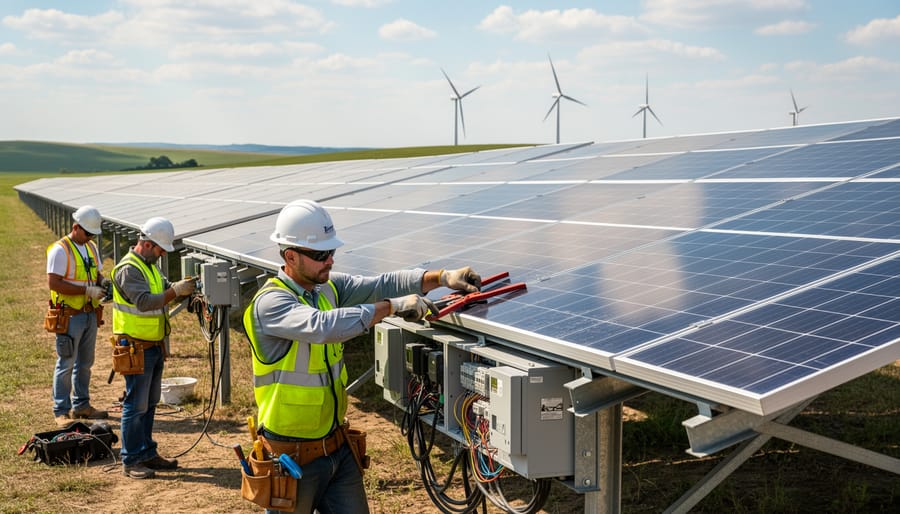
Despite the clear business case and regulatory momentum, corporations pursuing renewable energy strategies encounter substantial operational, financial, and structural obstacles that slow progress. Grid infrastructure stands among the most pressing technical barriers. The existing U.S. transmission network was built for centralized fossil fuel generation, not the distributed, variable nature of solar and wind resources. Corporations seeking to procure large volumes of renewable power through PPAs or build on-site installations frequently discover that local distribution systems lack the capacity to absorb additional generation or that connecting new renewable projects requires years-long interconnection queues and costly grid upgrades. These infrastructure constraints force companies to either delay projects, accept suboptimal locations, or fund transmission improvements themselves.
Financing complexities present another significant hurdle. While renewable energy costs have dropped dramatically, the upfront capital requirements for solar arrays, wind turbines, and battery storage remain substantial. Corporate finance teams accustomed to traditional energy procurement through utility bills must now evaluate 15-to-25-year contracts, navigate tax equity structures, and assess complex risk allocations in virtual PPAs. Smaller corporations without dedicated energy teams often lack the expertise to structure these deals effectively, putting them at a disadvantage compared to technology giants and multinational manufacturers that have built specialized renewable procurement functions.
The regulatory uncertainty pervading U.S. climate policy creates planning challenges. Following the SEC’s March 2025 withdrawal of its defense of federal climate disclosure rules, corporations face a patchwork landscape where California mandates comprehensive emissions reporting under SB 253 while most states impose no requirements at all. This fragmentation makes it difficult to design national sustainability strategies or justify renewable investments based solely on compliance risk. Companies operating across multiple states must either adopt the strictest standard everywhere or maintain separate reporting and procurement approaches by jurisdiction, adding administrative complexity and cost.
Internal organizational barriers often prove as difficult as external constraints. Energy procurement typically sits within facilities or operations departments, while sustainability goals originate from ESG teams reporting to corporate leadership. This structural separation creates misalignment between those setting renewable targets and those responsible for executing them. Legacy relationships with utility providers, established budgeting processes that favor predictable monthly bills over long-term contracts, and internal resistance to change all slow corporate energy transition efforts, even when senior leadership has committed to ambitious renewable goals.
The Path Forward: Integration of Renewable Energy and Corporate Strategy
The traditional organizational model that segregated sustainability initiatives from core business operations is rapidly dissolving. Leading corporations now recognize that renewable energy procurement cannot function as a peripheral environmental program managed by a single department. Instead, energy strategy must integrate across finance, operations, risk management, and executive planning. This shift reflects a fundamental recognition: in an era where energy costs directly impact margins, grid reliability affects operational continuity, and emissions performance influences capital access, renewable energy decisions are business decisions.
Chief financial officers now collaborate with sustainability teams to structure renewable energy investments that deliver measurable returns while reducing exposure to fossil fuel price volatility. Operations executives increasingly factor renewable energy availability into site selection decisions, recognizing that access to clean power infrastructure has become as critical as transportation networks or workforce availability. Risk officers incorporate energy transition scenarios into enterprise risk frameworks, evaluating how renewable procurement strategies position the company against potential carbon pricing mechanisms or supply chain disruptions linked to climate impacts.
This convergence accelerates when companies tie renewable energy targets directly to business resilience metrics. Organizations that previously viewed emissions reduction as compliance theater now treat it as operational optimization. The question shifts from “how do we meet reporting requirements?” to “how does our energy strategy strengthen competitive positioning?” Corporate renewable energy commitments increasingly drive facility design, manufacturing process upgrades, and partnership selection criteria.
The integration extends to capital allocation. Companies that once funded renewable projects through sustainability budgets now evaluate them alongside other infrastructure investments using standard financial metrics. Virtual power purchase agreements receive the same analytical rigor as facility expansions. Battery storage systems compete for capital against logistics automation. This normalization signals maturity: renewable energy has migrated from corporate social responsibility talking points to balance sheet considerations that boards scrutinize during quarterly reviews.
The U.S. corporate energy transition represents a fundamental shift in how businesses view renewable energy: no longer a peripheral sustainability initiative, but a strategic imperative integrated into financial planning, operational resilience, and competitive positioning. Despite the regulatory uncertainty following the SEC’s March 2025 withdrawal of its climate disclosure defense and the predominantly voluntary nature of federal ESG reporting, corporations continue accelerating renewable energy adoption at unprecedented rates. This momentum stems not from regulatory compliance alone, but from the compelling economics of solar and wind, the stability of long-term PPAs, and the growing recognition that energy procurement decisions directly impact bottom-line performance and stakeholder value.
The transformation is fundamentally technology-driven. Falling costs for solar PV installations, advances in battery storage systems, and the maturation of virtual PPA structures have made renewable energy financially competitive with traditional sources while delivering price certainty in volatile markets. California’s SB 253 requirements for Scope 1 and 2 disclosures beginning in 2026 demonstrate that state-level action continues to shape corporate behavior even absent comprehensive federal mandates, creating a patchwork environment where forward-looking companies adopt consistent national strategies rather than navigating fragmented regional requirements.
The path forward is clear: renewable energy has become embedded in corporate DNA, driving decisions from facility design to supply chain management. Companies that treat the energy transition as merely a compliance exercise will find themselves at a competitive disadvantage against those recognizing it as a business opportunity. The question is no longer whether corporations will adopt renewable energy, but how quickly they can execute strategies that align sustainability commitments with operational excellence and financial performance.
