








US Solar News That Actually Matters to Your Business Right Now
The US solar industry stands at a critical inflection point in 2024, with installations expected to surge past 40 gigawatts despite persistent headwinds from supply chain constraints and policy uncertainty. Federal investment tax credits now extend through 2034 following the Inflation Reduction Act’s passage, while domestic manufacturing incentives have triggered over $15 billion in announced factory investments across photovoltaic cells, modules, and inverter production facilities. Yet this expansion unfolds against a complex backdrop: interconnection queues averaging 3-5 years delay project completeness, tariff fluctuations on Southeast Asian imports create procurement volatility, and utility-scale developers navigate fragmented state-level permitting frameworks that vary dramatically from Texas’s streamlined approach to California’s rigorous environmental reviews.
Market fundamentals remain compelling. Utility-scale solar now achieves levelized costs below $30 per megawatt-hour in optimal regions, undercutting conventional generation without subsidies. Bifacial modules and tracker technology have boosted energy yields by 20-35 percent compared to fixed-tilt systems from five years ago. Meanwhile, distributed solar adoption accelerates beyond traditional residential markets into commercial and industrial segments seeking energy cost predictability amid grid rate increases.
This analysis examines five dimensions shaping America’s solar trajectory: legislative frameworks driving deployment acceleration, technological innovations enhancing performance economics, supply chain restructuring toward domestic resilience, landmark projects defining utility-scale standards, and regulatory obstacles threatening timeline execution. Understanding these interconnected forces proves essential for stakeholders positioning within the world’s second-largest solar market.
The Current State of US Solar: Breaking Down the Numbers
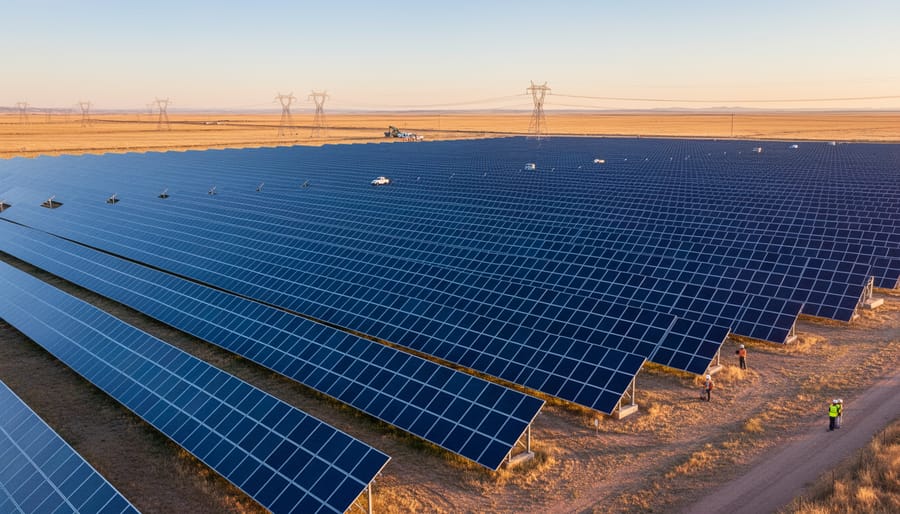
The United States solar industry continues its robust expansion trajectory, with recent data revealing remarkable momentum across all market segments. According to the latest US Solar Market Insight report, the nation added over 32 gigawatts (GW) of solar capacity in 2023, representing a 51% increase from the previous year. This surge has elevated total installed solar capacity to approximately 160 GW, sufficient to power more than 28 million American homes.
The fourth quarter of 2023 marked a particularly strong performance, with 18.2 GW installed—the highest quarterly total in US history. This acceleration reflects both improving supply chain conditions and favorable policy momentum following the Inflation Reduction Act’s implementation. Market analysts project sustained growth through 2024, with installations expected to reach 35-40 GW annually over the next five years.
| Metric | 2023 | 2024 Projection | Growth Rate |
|---|---|---|---|
| Total Installations | 32.4 GW | 37.9 GW | +17% |
| Residential Segment | 6.8 GW | 7.2 GW | +6% |
| Commercial Segment | 3.1 GW | 3.8 GW | +23% |
| Utility-Scale Segment | 22.5 GW | 26.9 GW | +20% |
| Total Investment | $42.1B | $48.5B | +15% |
Geographic distribution reveals significant concentration in sun-rich states, with California, Texas, and Florida collectively accounting for nearly 55% of new installations in 2023. However, emerging markets in the Southeast and Midwest are demonstrating accelerated adoption rates, driven by improved economics and supportive state-level initiatives.
The utility-scale segment maintains market dominance, contributing approximately 70% of total capacity additions. Nevertheless, the residential sector shows resilience despite interest rate headwinds, while commercial solar experiences renewed interest following enhanced tax credit provisions. Battery storage integration has become increasingly prevalent across all segments, with energy storage attachments reaching 45% for utility projects and 25% for residential systems.
This multifaceted growth underscores the solar industry’s maturation from niche technology to mainstream energy infrastructure, positioning photovoltaic power as a cornerstone of America’s evolving electricity generation portfolio.
Policy Shifts Reshaping the US Solar Landscape
Federal Incentives and the Inflation Reduction Act Impact
The Inflation Reduction Act provisions have fundamentally reshaped the financial landscape for solar development in the United States, introducing an estimated $369 billion in clean energy investments through 2032. The legislation’s cornerstone mechanisms—the Production Tax Credit (PTC) and Investment Tax Credit (ITC)—now offer developers unprecedented flexibility, with the ITC providing a 30% base credit for solar installations through 2032, gradually stepping down to 26% in 2033 and 22% in 2034.
The domestic content bonus represents a strategic shift toward supply chain localization, offering an additional 10% credit adder for projects meeting stringent domestic manufacturing thresholds. Projects must source steel, iron, and manufactured products predominantly from U.S. facilities, creating both opportunities for domestic manufacturers and compliance challenges for developers accustomed to global procurement. Early implementation has revealed significant documentation requirements, with the Treasury Department issuing detailed guidance on certification processes that many developers find administratively burdensome.
Energy community bonuses add another 10% credit for projects located in brownfield sites, coal closure areas, or census tracts with significant fossil fuel employment history. This provision incentivizes development in economically transitioning regions, though identifying qualifying locations and navigating local permitting in these areas presents practical hurdles. Developers report that combining multiple adders—domestic content, energy community, and low-income community bonuses—can theoretically increase project economics by 30-50%, though few projects currently qualify for the full suite of benefits.
The real-world implementation challenges extend beyond documentation. Supply chain constraints for domestically manufactured components, evolving Treasury guidance on technical requirements, and the complexities of tax equity structuring for projects utilizing PTCs instead of ITCs have created a learning curve across the industry, requiring developers to build new expertise in regulatory compliance and financial engineering.
State-Level Developments: Who’s Leading and Who’s Lagging
The solar landscape across America reveals a tale of divergent trajectories, with state-level policies creating dramatically different market conditions. Several states are emerging as solar powerhouses through progressive legislation, while others face mounting regulatory headwinds.
California maintains its leadership position despite recent modifications to its net metering program (NEM 3.0), which reduced export compensation rates but increased incentives for battery storage pairing. The state’s grid operators continue refining interconnection procedures to accommodate the substantial solar capacity already online while planning for future growth.
Texas presents an intriguing case, experiencing explosive solar expansion driven primarily by wholesale market economics rather than mandated renewable portfolio standards. Large-scale utility projects dominate the landscape, with developers capitalizing on abundant land and favorable solar irradiance conditions.
Florida has accelerated its solar trajectory following legislative reforms that simplified permitting processes and expanded third-party ownership options. The state’s combination of strong solar resources and growing population positions it as a critical emerging market for both residential and commercial installations.
Conversely, several states face concerning policy reversals. Indiana recently weakened its net metering provisions, substantially reducing compensation for distributed solar generation. Similar rollbacks in Nevada and Arizona have created market uncertainty, temporarily dampening installation rates as developers reassess project economics.
The Northeast corridor demonstrates mixed results. New York’s Value of Distributed Energy Resources tariff continues evolving, creating complexity but maintaining robust market fundamentals. Massachusetts confronts interconnection queue challenges despite strong policy support, illustrating how administrative bottlenecks can hinder otherwise favorable conditions.
For comprehensive tracking of these evolving policies, DSIRE policy resources provide regularly updated information across all jurisdictions. Industry participants must monitor these state-level developments closely, as regulatory frameworks increasingly determine market viability and project returns in specific regions.
Technology Innovations Emerging from US Markets
The US solar sector continues to push the boundaries of photovoltaic technology, with multiple breakthrough innovations reaching commercialization in 2024. These advancements are fundamentally reshaping project economics and expanding deployment possibilities across diverse geographical and climatic conditions.
Module efficiency gains represent the most significant technological leap, with several US manufacturers now producing panels exceeding 24% efficiency for commercial applications. Leading the charge, heterojunction technology has moved beyond laboratory settings into mass production, with facilities in Georgia and Texas delivering panels that combine crystalline silicon with thin-film layers to minimize energy loss. Meanwhile, tandem perovskite-silicon cells have achieved conversion efficiencies approaching 30% in pilot programs, though commercial scalability remains under development. These efficiency improvements directly translate to reduced land requirements and lower balance-of-system costs, making solar increasingly competitive in space-constrained urban environments.
Bifacial module adoption has accelerated dramatically across US utility-scale projects, with market penetration now exceeding 40% of new installations. These dual-sided panels capture reflected light from ground surfaces, increasing energy yield by 10-25% depending on site conditions and albedo characteristics. Enhanced by specialized tracking systems that optimize the angle for both direct and reflected radiation, bifacial technology delivers particularly strong performance in snowy regions and desert environments with reflective terrain.
Energy storage integration has evolved from optional add-on to standard design consideration, driven by technological maturation and favorable economics. Advanced inverter technology now enables seamless AC and DC coupling configurations, with smart algorithms managing charge-discharge cycles to maximize revenue under increasingly sophisticated time-of-use rate structures. Battery management systems incorporating artificial intelligence predict demand patterns and weather conditions, optimizing storage dispatch to capture peak pricing opportunities while maintaining grid reliability.
Tracking system innovations continue refining solar’s capture potential. Next-generation single-axis trackers now incorporate machine learning algorithms that account for diffuse radiation patterns, row-to-row shading, and real-time weather data to determine optimal positioning throughout the day. Some advanced systems even implement backtracking algorithms that prevent self-shading during low sun angles, recovering energy production that traditional fixed-angle approaches sacrifice.
Emerging technologies under field testing include floating solar systems adapted for US reservoirs and agricultural canals, transparent solar panels for building integration, and quantum dot coatings that enhance spectral absorption. These innovations signal continued diversification in deployment strategies, addressing both technical performance and aesthetic considerations that previously limited certain market segments.
Supply Chain Dynamics: Manufacturing and Trade Developments
The US solar supply chain is undergoing a fundamental transformation as the industry pivots from decades of import dependence toward domestic manufacturing capability. This shift, accelerated by policy incentives and trade enforcement actions, carries significant implications for project economics and procurement strategies across the sector.
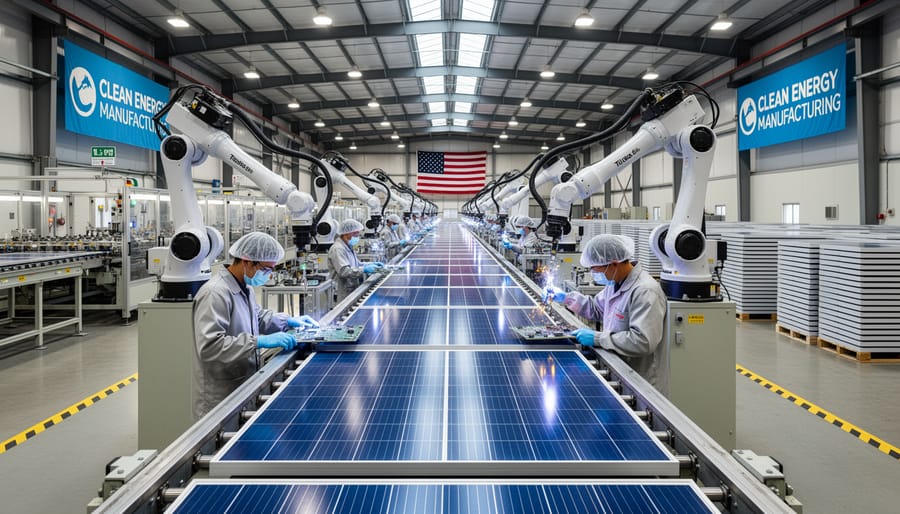
The Inflation Reduction Act’s Advanced Manufacturing Production Credit has catalyzed unprecedented investment in domestic solar manufacturing. Multiple gigawatt-scale facilities for polysilicon, ingots, wafers, cells, and modules are either under construction or recently operational, with manufacturers including First Solar, Qcells, and new entrants committing over $20 billion in combined capacity expansion. This represents a dramatic departure from the historic reliance on Asian supply chains, particularly from Southeast Asian nations that previously accounted for approximately 80 percent of US module imports.
However, this transition period introduces complexity for project developers navigating overlapping trade policies. Anti-dumping and countervailing duties on Chinese solar products remain in effect, while anti-circumvention investigations targeting manufacturers in Thailand, Vietnam, Malaysia, and Cambodia have created procurement uncertainty. The Commerce Department’s findings that certain manufacturers illegally circumvented Chinese tariffs by routing production through these countries resulted in retroactive duties for some importers, though a two-year bridge provided temporary relief for specific solar cells and modules.
These developments necessitate strategic procurement adjustments. Developers increasingly evaluate total cost of ownership rather than spot pricing alone, factoring in tariff exposure, supply chain resilience, and the 10 percent domestic content adder available under IRA guidelines. The definition of domestic content requires specific thresholds for manufactured products and domestic iron and steel usage, creating opportunities for US-made components even as full domestic supply chains mature.
The supply chain evolution extends beyond modules to balance-of-system components. Tracker manufacturers, inverter producers, and mounting system suppliers are establishing US production facilities to capture domestic content premiums and reduce logistics vulnerabilities exposed during recent shipping disruptions. This broader ecosystem development strengthens the foundation for sustained domestic solar manufacturing competitiveness beyond initial policy support periods, though challenges around skilled workforce availability and raw material sourcing persist.

Major Projects and Utility-Scale Developments
The utility-scale solar sector continues its robust expansion across the United States, with several landmark projects demonstrating evolving technological preferences and financing strategies that signal important trends for the industry.
Among the most significant recent announcements is the 1.3-gigawatt Samson Solar Energy Center in Texas, which recently achieved commercial operation status. This project represents one of the largest single-site solar installations in the nation and features bifacial solar modules paired with single-axis tracking systems, a configuration increasingly favored for maximizing energy yield in utility-scale deployments. The project’s power purchase agreements with multiple corporate offtakers, including telecommunications and technology companies, exemplify the growing trend of direct corporate renewable energy procurement rather than traditional utility contracts.
In the Southeast, Duke Energy’s 600-megawatt Copper Crossing solar facility in Texas showcases the integration of battery energy storage systems alongside solar generation. The 150-megawatt storage component demonstrates how utilities are increasingly viewing solar-plus-storage as essential infrastructure rather than standalone generation assets. This hybrid approach addresses intermittency concerns while providing grid stabilization services that command premium revenue streams.
The financing landscape has evolved considerably, with tax equity partnerships remaining dominant but increasingly complemented by innovative structures. Several projects have successfully utilized transferable tax credits introduced through the Inflation Reduction Act, enabling developers to monetize incentives more efficiently without traditional tax equity structures. This democratization of project finance has particularly benefited smaller developers and community-scale projects.
From a technological perspective, module efficiency improvements continue driving site economics. Recent utility-scale installations increasingly specify modules exceeding 22 percent efficiency, with some projects incorporating heterojunction and TOPCon technologies previously reserved for residential applications. These efficiency gains reduce land requirements and balance-of-system costs, improving project returns even as module prices face pressure from supply chain dynamics and trade policy uncertainties.
The geographic distribution of new projects reflects both renewable portfolio standard requirements and merchant market economics, with Texas, California, and Florida leading development pipelines. However, emerging markets in the Midwest, driven by manufacturing load growth and data center expansion, represent significant opportunities for future utility-scale deployment.
Challenges Facing US Solar Deployment
Despite strong market fundamentals and policy support, the US solar industry confronts several systemic challenges that threaten to constrain deployment velocity and increase project costs. Understanding these obstacles provides essential context for assessing near-term market dynamics and investment opportunities.
Interconnection delays represent perhaps the most significant barrier to accelerated solar deployment. The national interconnection queue has swelled to over 2,000 gigawatts of proposed capacity, with solar and storage projects waiting an average of five years to receive grid connection approvals. This backlog stems from outdated interconnection procedures, understaffed grid operators, and transmission infrastructure inadequate for the geographic distribution of renewable resources. Recent Federal Energy Regulatory Commission reforms attempt to streamline these processes, but implementation remains inconsistent across regional transmission organizations.
- Interconnection Queue
- The waiting list of generation projects seeking permission to connect to the electrical grid, currently experiencing unprecedented backlogs that delay project completion by multiple years.
- Transmission Constraints
- Physical limitations in the electrical grid’s capacity to move power from generation sites to demand centers, particularly acute for remote solar installations requiring new infrastructure buildout.
- Safe Harbor Provisions
- Tax credit eligibility rules allowing developers to lock in incentive rates by demonstrating project progress, creating strategic equipment procurement windows during policy transitions.
The interconnection challenge connects directly to broader transmission inadequacy, as solar resources concentrate in high-irradiance regions distant from major load centers.
Permitting bottlenecks compound timeline uncertainty, with large-scale projects navigating complex multi-jurisdictional approval processes spanning federal, state, and local authorities. Environmental reviews under the National Environmental Policy Act, while serving important protective functions, can extend timelines by years for utility-scale installations. State-level siting regulations vary dramatically, creating disparate development environments where identical projects face wildly different approval trajectories.
Labor shortages increasingly constrain installation capacity despite robust project pipelines. The industry requires an estimated 700,000 workers by 2030 to meet deployment targets, yet faces competition from other construction sectors and insufficient training infrastructure. Specialized skills in electrical work, engineering, and project management command premium wages but remain in short supply.
Financing constraints persist despite improved project economics, particularly for community solar and distributed generation. Rising interest rates have increased capital costs, while supply chain disruptions and inflation have eroded return expectations. These headwinds disproportionately impact smaller developers lacking established banking relationships or balance sheet strength.
What US Developments Mean for Global Solar Markets
The United States solar market functions as a critical bellwether for global photovoltaic development, making American policy shifts and market dynamics essential intelligence for international energy professionals. Understanding US developments provides strategic foresight into supply chain evolution, technology commercialization pathways, and investment patterns that ripple across continents.
US policy frameworks, particularly the Inflation Reduction Act’s manufacturing incentives and domestic content requirements, are fundamentally reshaping global solar supply chains. These provisions drive manufacturers to establish production facilities in North America while simultaneously creating competitive pressures for European and Asian markets to develop their own localized manufacturing ecosystems. International module producers face strategic decisions about market access versus tariff exposure, directly influencing global capacity planning and technology transfer patterns.
Technology adoption patterns in the United States frequently preview worldwide trends. When American utility-scale developers embrace bifacial modules, advanced tracker systems, or integrated battery storage at scale, equipment manufacturers prioritize these technologies for global deployment. The US market’s size and purchasing power accelerate cost reductions through manufacturing scale economies that benefit solar installations worldwide. Similarly, distributed generation innovations pioneered in American residential and commercial sectors often inform regulatory frameworks and business models in emerging markets.
Supply chain dynamics originating from US trade policy create cascading effects internationally. Tariff structures on cells, modules, and components from specific countries redirect manufacturing investment, alter pricing structures across regions, and influence technology development priorities. The circumvention investigations and anti-dumping measures implemented by US authorities establish precedents that other nations reference when crafting their own trade protections.
Financial innovations developed within American solar markets, including tax equity structures, green bonds, and power purchase agreement frameworks, provide templates for international project finance. As US institutions deploy capital globally, they export these proven financing mechanisms, accelerating solar deployment in markets with less mature financial infrastructure.
For international professionals, monitoring US developments offers competitive intelligence on emerging technologies before global rollout, early indicators of supply chain reconfigurations, and insights into policy approaches that may influence their domestic markets. The American solar sector’s trajectory ultimately shapes manufacturing priorities, technology roadmaps, and investment flows that determine the pace and direction of the worldwide energy transition.

The United States solar market continues to serve as a critical barometer for global photovoltaic industry trends, making sustained engagement with US solar news essential for professionals across the renewable energy sector. From groundbreaking technological innovations in perovskite tandem cells and bifacial modules to evolving policy frameworks that shape investment landscapes, developments in the American market frequently cascade into international adoption patterns and manufacturing strategies.
Staying informed about US solar developments provides actionable intelligence for decision-makers worldwide. Supply chain reconfigurations, domestic manufacturing initiatives, and utility-scale deployment strategies emerging from the United States often forecast broader industry shifts that affect procurement decisions, project economics, and competitive positioning across global markets. The interplay between federal incentives, state-level mandates, and market-driven innovation creates a dynamic ecosystem whose lessons translate far beyond American borders.
For solar consumers, installers, developers, and industry specialists, regular engagement with comprehensive US solar coverage offers more than situational awareness—it provides strategic foresight. Understanding how interconnection queue reforms resolve deployment bottlenecks, how tariff structures influence supply chain decisions, or how emerging storage integration standards evolve can directly inform operational and investment strategies regardless of geographic focus.
As the solar industry continues its trajectory toward becoming the world’s dominant energy source, the United States remains a pivotal market where technological breakthroughs, policy experiments, and commercial models undergo real-world validation. Maintaining awareness of these developments positions professionals to anticipate shifts, identify opportunities, and navigate challenges in an increasingly interconnected global solar landscape.
