





Hydroelectric Power: 12 Essential Facts Shaping Modern Energy Infrastructure
Hydroelectric power generates approximately 16% of global electricity and 60% of all renewable energy production in 2026, making it the world’s largest source of clean electricity by a substantial margin. This technology converts the kinetic energy of flowing or falling water into mechanical energy through turbines, which then drive generators to produce electricity. With an average capacity factor exceeding 40% and operational lifespans stretching beyond 100 years for many facilities, hydroelectric installations deliver baseload power that intermittent sources like solar and wind cannot match without energy storage.
The scale of global hydropower deployment reaches 1,400 gigawatts of installed capacity across more than 160 countries, with China, Brazil, Canada, and the United States operating the largest portfolios. Yet this mature technology faces intensifying scrutiny over its environmental footprint, particularly regarding methane emissions from reservoirs, disruption of river ecosystems, and displacement of communities during dam construction. Economic performance varies dramatically based on project scale, with large facilities achieving levelized costs below $50 per megawatt-hour while run-of-river and pumped storage systems carry different cost structures.
Understanding these operational realities proves essential for energy professionals evaluating hydropower’s role in an energy transition strategy that balances grid stability, environmental responsibility, and economic viability. The following analysis examines technical specifications, environmental metrics, economic benchmarks, and practical limitations that define hydroelectric power’s contribution to global decarbonization efforts.
Scale and Global Contribution
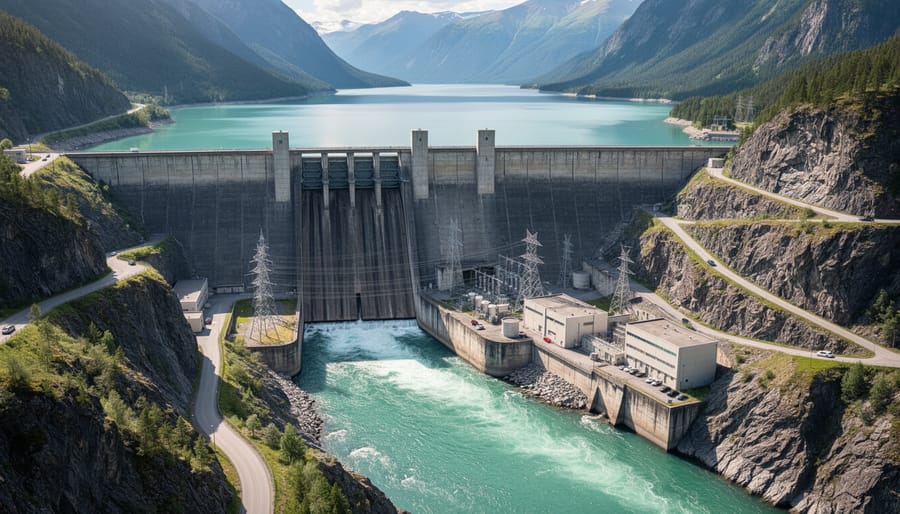
Hydroelectric power stands as the world’s largest source of renewable electricity, with approximately 1,400 gigawatts of installed capacity generating over 4,300 terawatt-hours annually. This output represents roughly 16 percent of global electricity generation and nearly 60 percent of all renewable energy production worldwide, dwarfing the combined contribution of wind and solar despite their rapid recent growth.
The geographic distribution of hydroelectric capacity reflects both natural hydrological resources and historical infrastructure investment. China dominates global production with over 370 GW of installed capacity, having added more than 200 GW in the past two decades through massive projects including the Three Gorges Dam and extensive development across southwestern provinces. Brazil ranks second with approximately 109 GW, leveraging the Amazon basin and Paraná River system to supply over 60 percent of the nation’s electricity from hydropower alone.
| Country | Installed Capacity (GW) | Annual Generation (TWh) | Share of National Electricity |
|---|---|---|---|
| China | 370 | 1,300 | 17% |
| Brazil | 109 | 410 | 63% |
| Canada | 82 | 400 | 60% |
| United States | 103 | 290 | 7% |
Canada and the United States follow with 82 GW and 103 GW respectively, though their generation outputs differ significantly due to varying capacity factors and operational strategies. Canada derives approximately 60 percent of its electricity from hydropower, while the United States generates only 7 percent from hydro within a much larger and more diversified grid.
Beyond these leaders, substantial hydroelectric capacity exists across Norway (33 GW), India (51 GW), and Russia (51 GW), with ongoing developments concentrated in Southeast Asia, East Africa, and South America where untapped potential remains significant. Current global expansion adds roughly 25-30 GW of new capacity annually, primarily through large projects in developing economies and pumped-storage installations in markets prioritizing grid flexibility.
How Hydroelectric Systems Generate Electricity
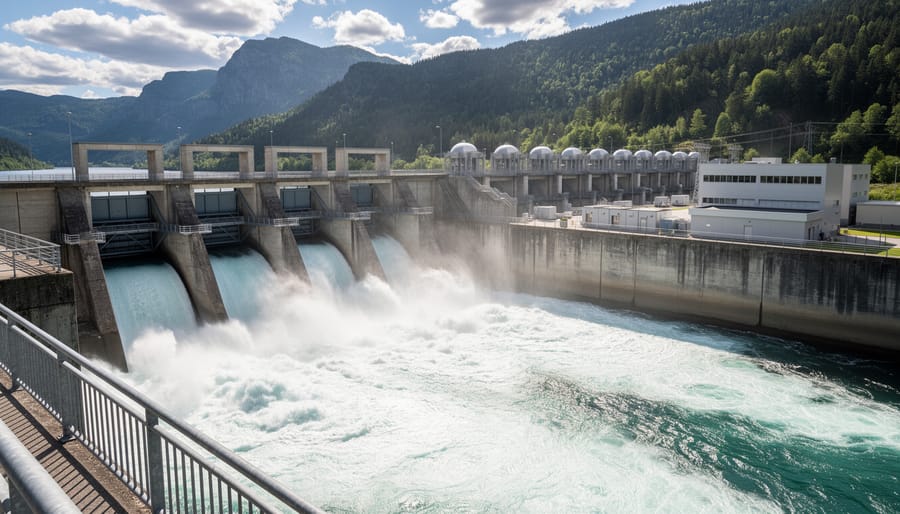
Hydroelectric systems transform the kinetic and potential energy of moving water into electrical power through a process that achieves about 90% efficiency far surpassing the 33-45% efficiency typical of coal or natural gas plants. At its core, the technology exploits gravitational potential energy: water stored at elevation holds energy proportional to its mass and height above the turbine. When released, gravity accelerates the water downward, converting stored potential energy into kinetic energy that spins turbine blades.
The power output of a hydroelectric facility depends on two primary variables: head and flow rate. Head refers to the vertical distance water falls between the intake and the turbine, measured in meters or feet. Flow rate quantifies the volume of water passing through the system per unit time, typically expressed in cubic meters per second. These factors combine in the fundamental power equation: P = ρ × g × h × Q × η, where P is power in watts, ρ is water density (1,000 kg/m³), g is gravitational acceleration (9.81 m/s²), h is head in meters, Q is flow rate in m³/s, and η represents efficiency. A facility with 100 meters of head and 50 m³/s flow operating at 90% efficiency generates approximately 44 megawatts.
The physical conversion happens in stages. Water enters through intake structures and travels via penstock pipes to the powerhouse, accelerating as elevation decreases. Inside the powerhouse, high-velocity water strikes turbine blades arranged around a central shaft. Different turbine designs suit different conditions: Francis turbines handle medium heads (10-350m) with variable flow, Kaplan turbines excel at low heads with adjustable blade pitch, and Pelton wheels efficiently convert high heads (300m+) using water jets. As the turbine spins, it drives a generator rotor through a direct mechanical coupling. The rotating magnetic field inside the generator induces alternating current in stationary wire coils, producing electricity at grid-compatible voltage and frequency.
The exceptional efficiency stems from direct mechanical coupling with minimal energy loss. Unlike thermal plants that waste heat during combustion and steam condensation, hydroelectric facilities lose energy primarily through friction in penstocks and mechanical resistance in turbines and bearings. Modern installations achieve 92-95% efficiency at optimal operating conditions, though real-world performance averages slightly lower due to part-load operation and seasonal flow variations.
Types of Hydroelectric Facilities
Impoundment and Storage Systems
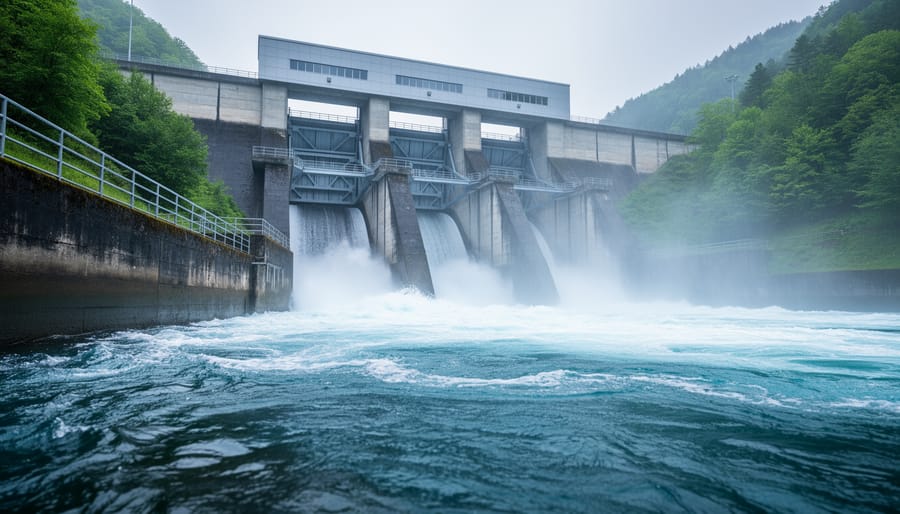
Impoundment systems account for the majority of global hydroelectric capacity, using dams to create reservoirs that store water at elevation. This storage enables operators to control generation timing independent of natural inflow patterns, releasing water through turbines when electricity demand peaks.
These facilities achieve capacity factors of 50-90%, substantially higher than run-of-river installations, because stored water allows consistent generation even during dry periods. The largest projects exceed 10,000 MW, China’s Three Gorges Dam generates 22,500 MW, equivalent to roughly twenty nuclear reactors. Medium-scale facilities typically range from 100-1,000 MW, while smaller impoundment plants operate at 10-100 MW.
The key advantage is dispatchability: operators can ramp output from zero to full capacity within minutes, providing load-following capability that complements variable solar and wind generation. Multi-year storage in large reservoirs buffers against drought cycles, with some systems designed to store energy across seasons, capturing spring snowmelt for summer peak demand or wet-season flows for dry-season use.
Project lifespans commonly exceed seventy-five years, making these infrastructure investments that serve multiple generations while maintaining low operating costs after initial construction.
Run-of-River Installations
Run-of-river installations harness flowing water without creating large reservoirs, diverting a portion of a river through turbines before returning it downstream. These facilities typically have minimal or no water storage capacity, often just hours rather than days or months, making them fundamentally dependent on natural stream flow.
This design constraint creates significant seasonal variability. Run-of-river plants in snowmelt-dependent regions might operate at 80-90% capacity during spring runoff but drop to 20-30% in late summer. Annual capacity factors average 35-50%, substantially lower than the 50-90% typical of storage-based systems. This variability limits their role in meeting peak demand, though they provide consistent baseload during high-flow periods.
The environmental benefits are considerable. Without flooding large land areas, run-of-river projects preserve terrestrial ecosystems and avoid displacing communities. They maintain more natural flow patterns, reducing impacts on fish migration and sediment transport compared to conventional dams. Many incorporate fish-friendly turbine designs and bypass channels.
Power output remains modest, most run-of-river facilities generate between 1-50 MW, though some reach 100+ MW on large rivers. The technology suits regions with consistent year-round flow or where environmental regulations restrict reservoir development, making it a complementary rather than replacement option for storage hydropower.
Pumped-Storage Hydropower
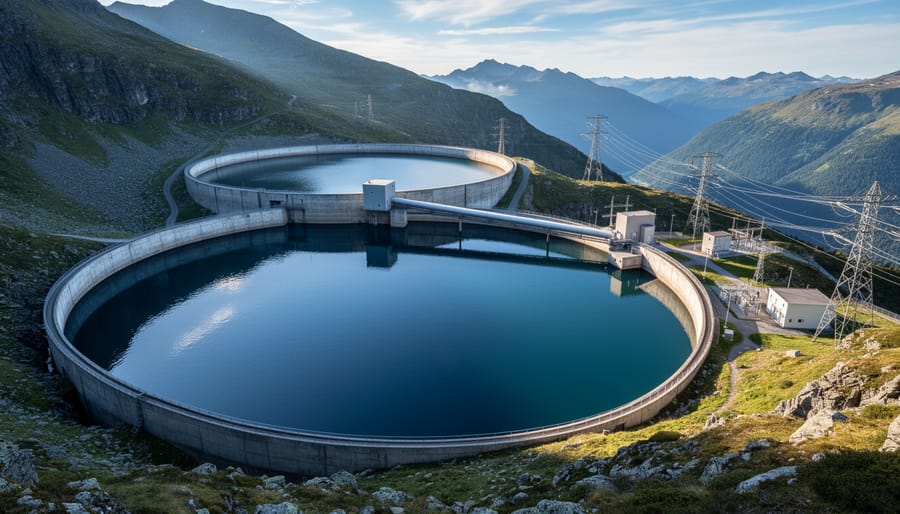
Pumped-storage hydropower operates on a deceptively simple principle: water is pumped uphill to an upper reservoir during periods of low electricity demand or excess renewable generation, then released through turbines to generate power when demand peaks. This reversible process creates what amounts to a massive battery, converting electrical energy into gravitational potential energy and back again. The technology achieves round-trip efficiency of 70-85%, meaning that for every 100 units of electricity used to pump water upward, 70-85 units can be recovered during generation, a performance that rivals or exceeds most battery storage systems at utility scale.
Global installed capacity currently stands at roughly 160 GW, with China, the United States, and Japan operating the largest fleets. Unlike conventional hydroelectric facilities that depend on river flow, pumped-storage systems can be sited in locations with suitable elevation differences but minimal water inflow, reducing environmental conflicts. Modern designs increasingly employ closed-loop configurations that circulate the same water between reservoirs rather than diverting rivers.
The technology’s value extends beyond simple energy storage. Pumped-storage plants provide rapid frequency regulation, voltage support, and the ability to ramp from full pumping to full generation in under two minutes, capabilities that become more valuable as solar and wind penetration increases. Development pipelines show significant expansion, particularly in regions integrating large renewable portfolios, with advanced designs incorporating variable-speed turbines that optimize efficiency across wider operating ranges.
Environmental Impact Profile
Carbon Emissions and Climate Benefits
Hydroelectric power delivers among the lowest lifecycle greenhouse gas emissions of any electricity source. Modern assessments place typical hydroelectric facilities at 4-18 gCO2eq/kWh, roughly 50-100 times cleaner than coal-fired generation and comparable to wind and solar photovoltaic systems. This climate advantage holds across the operational lifespan, with most emissions occurring during construction rather than generation.
Reservoir-based facilities warrant closer examination due to methane production from submerged organic matter decomposition. Emission rates vary dramatically by location: tropical reservoirs flooding dense vegetation can release 50-100 gCO2eq/kWh in initial decades, while boreal or arid-region projects remain well below 20 gCO2eq/kWh throughout operation. Design choices matter significantly, shallow flooding depth, pre-impoundment vegetation clearing, and reservoir shape influence long-term emissions profiles.
Run-of-river installations avoid most reservoir methane concerns, typically matching lifecycle emissions of what is geothermal energy at 4-10 gCO2eq/kWh. Modern project assessments now include 100-year global warming potential calculations, accounting for both carbon dioxide from construction and methane releases, providing standardized comparison across renewable technologies and geographic contexts.
Ecosystem and Hydrological Effects
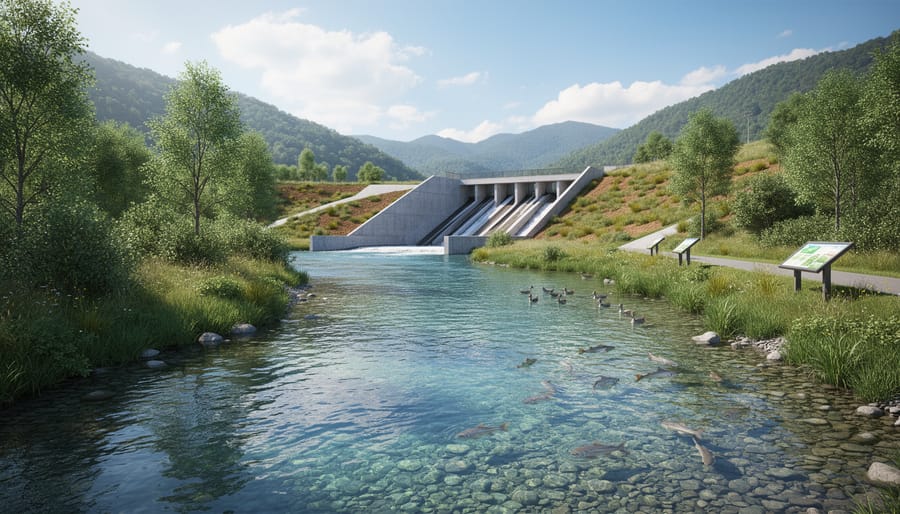
Hydroelectric dams alter river ecosystems by fragmenting habitats, blocking sediment transport, and changing downstream flow regimes. Natural sediment flow decreases by 25-100% below major reservoirs, affecting delta formation and riverbed composition hundreds of kilometers downstream. Temperature stratification in deep reservoirs changes downstream water quality, often releasing colder, oxygen-depleted water that disrupts native aquatic species adapted to natural thermal patterns.
Fish migration faces significant barriers at dam structures. Anadromous species like salmon experience population declines of 40-90% on heavily dammed rivers when passage infrastructure is absent. Modern facilities incorporate fish ladders, bypass channels, and screening systems that achieve passage rates of 85-95% for targeted species, though effectiveness varies by design and fish type. Some developments use trap-and-haul programs during critical migration periods.
Environmental flow releases now feature in contemporary projects, mimicking natural seasonal patterns to maintain downstream ecosystem function. These scheduled releases preserve habitat connectivity and support spawning cycles, though they reduce electricity generation by 5-15% compared to purely optimized operation. The environmental impact science continues evolving as monitoring technology improves assessment capabilities across longer timeframes.
Land Use and Social Considerations
Reservoir-based hydroelectric facilities occupy substantial land areas, with footprints ranging from 10 to over 400 square kilometers for large projects. The Three Gorges Dam in China inundated approximately 632 square kilometers, while modern run-of-river installations minimize this impact by eliminating or drastically reducing reservoir size.
Historical hydroelectric development displaced an estimated 40-80 million people globally between 1950 and 2000, with compensation and resettlement standards often inadequate. Contemporary projects operate under stricter frameworks: the International Finance Corporation’s Performance Standards and World Commission on Dams guidelines now mandate comprehensive social impact assessments, genuine community consultation, and equitable benefit-sharing before construction proceeds.
Land-use efficiency metrics have improved through technological advances. Modern turbine designs extract more energy from smaller reservoirs, while pumped-storage facilities increasingly utilize existing infrastructure or closed-loop systems that don’t flood new valleys. Floating solar installations on reservoir surfaces represent an emerging dual-use approach that maximizes energy output per hectare without additional land conversion.
Current best practice emphasizes revenue-sharing agreements, local employment guarantees, and infrastructure improvements for affected communities, shifting from displacement-focused models to partnership frameworks that recognize host communities as stakeholders rather than obstacles.
Economic and Technical Performance
Hydroelectric facilities demonstrate exceptional economic performance across multiple metrics, driven primarily by extraordinarily long operational lifespans and minimal fuel costs. Modern hydroelectric plants typically operate for 50 to 100 years, with many facilities built in the early 20th century still generating electricity profitably today. This longevity fundamentally changes the economic calculus compared to shorter-lived generation technologies.
Levelized cost of energy (LCOE) for hydroelectric power varies considerably by project type and location. Large storage facilities typically achieve LCOE values between $40 and $90 per megawatt-hour, while run-of-river installations range from $30 to $70 per megawatt-hour. These figures reflect high upfront capital costs offset by decades of low-cost operation. Pumped-storage facilities show higher LCOE ranges of $100 to $200 per megawatt-hour, but their value extends beyond pure energy generation to include grid flexibility services that command premium pricing.
Capacity factors reveal significant operational differences between configurations. Run-of-river plants typically achieve 35% to 50% capacity factors due to seasonal flow variations, while reservoir-based storage systems reach 50% to 90%, depending on water availability and operational strategy. These performance levels remain consistent year after year, unlike the degradation curves that affect solar panels and wind turbines.
Operating and maintenance costs for hydroelectric facilities average $10 to $25 per kilowatt per year, substantially lower than fossil fuel plants that must purchase fuel continuously. Maintenance requirements focus on mechanical components like turbines, generators, and gates, with major overhauls typically scheduled every 25 to 40 years. Modern predictive monitoring systems have reduced unplanned outages while extending equipment life.
When compared to solar and wind installations, hydroelectric projects require higher initial investment but deliver lower lifetime costs per megawatt-hour generated. The combination of century-scale asset life, zero fuel expense, and high reliability creates economic value that meets rigorous editorial standards for power system planning. This economic durability explains why hydroelectric capacity, once built, rarely retires.
Grid Integration and Reliability Value
Hydroelectric facilities deliver grid services that extend far beyond their electricity output numbers. Unlike thermal plants that require hours to ramp up or down, hydro turbines can shift from standby to full generation in two to ten minutes, and storage facilities can reverse flow direction within seconds to switch from generation to pumping mode. This rapid response makes hydropower invaluable for balancing sudden demand spikes or generation shortfalls across the network.
The technology excels at frequency regulation, maintaining the precise 50 or 60 Hz stability that grid-connected devices require. When solar or wind output drops unexpectedly, hydroelectric governors automatically adjust water flow to compensate within seconds, preventing the frequency deviations that can cascade into blackouts. Storage hydropower facilities provide this service continuously while simultaneously storing energy, a combination no battery technology currently matches at comparable scale.
Black-start capability represents another critical advantage. After a widespread grid failure, most power plants need external electricity to restart their systems. Large hydroelectric facilities can energize from a complete shutdown using only battery banks or small diesel generators, then provide the stable power necessary to restart thermal plants and rebuild the network. Major blackout recovery plans across North America and Europe rely on this hydropower attribute.
Grid operators increasingly recognize these reliability services in market designs and capacity payments. The value proposition shifts as variable renewables expand, a hydroelectric plant providing 500 MW of dispatchable capacity with millisecond response times offers fundamentally different grid support than 500 MW of baseload nuclear or intermittent wind, even when annual energy output appears similar. This ancillary services value, difficult to quantify in simple cost-per-kilowatt-hour comparisons, explains why pumped storage investments continue despite energy-only economics that might favor batteries.
Emerging Technologies and Innovation Trends
While conventional hydroelectric technology reached maturity decades ago, the sector continues advancing through incremental efficiency gains and digital transformation. Modern turbine designs now achieve 95% energy conversion efficiency, up from 85-90% in older installations, through computational fluid dynamics optimization and advanced materials that reduce friction losses. These improvements translate directly into higher output from existing water resources without additional environmental impact.
Modular hydrokinetic systems represent a departure from traditional dam-based generation. These underwater turbines harness flowing water in rivers and tidal zones without impoundments, operating similarly to wind turbines but underwater. Current installations generate 10-250 kW per unit, making them viable for remote communities and distributed generation applications where conventional hydroelectric development proves impractical.
In-conduit generation captures energy from existing water infrastructure, municipal supply pipes, irrigation canals, and wastewater systems, by installing small turbines in already-flowing water. This approach adds generation capacity without new environmental footprint, utilizing pressure differentials that currently dissipate as waste. Hundreds of such installations now operate globally, each producing 5-500 kW depending on pipe diameter and flow characteristics.
Digital control systems increasingly optimize hydroelectric operations through real-time adjustments. Machine learning algorithms predict inflow patterns, coordinate multiple plants across river basins, and balance power output with water management objectives. Predictive maintenance using sensor networks and AI analysis reduces unplanned downtime by identifying bearing wear, cavitation damage, and other issues before failure occurs, critical for facilities where turbine repairs require lengthy shutdowns.
Fish-friendly turbine designs address one of hydropower’s persistent environmental challenges. New configurations feature wider blade spacing, slower rotation speeds, and shaped passages that reduce injury rates for migrating fish by 90%+ compared to conventional Kaplan turbines, though at modest efficiency trade-offs.
Hybrid systems pairing hydroelectric facilities with floating solar arrays on reservoir surfaces demonstrate synergistic potential. The solar component generates during peak daylight hours while the hydroelectric system provides stability and storage, sharing transmission infrastructure and operating permits. Several large-scale demonstrations now operate in Portugal, Thailand, and California, combining technologies that align with future baseload trends in renewable energy integration.
Frequently Asked Questions
Hydroelectric facilities have compiled an exceptional safety record over decades of operation, with modern dam engineering standards and monitoring systems maintaining structural integrity across thousands of installations worldwide. Catastrophic failures remain statistically rare, and contemporary designs incorporate multiple redundant safety mechanisms, seismic protections, and real-time structural health monitoring that far exceed historical standards.
How does hydroelectric efficiency compare to solar and wind power?
Hydroelectric turbines convert 90% or more of available energy into electricity, significantly higher than solar panels (15-22%) or wind turbines (35-45%). However, efficiency metrics alone don’t determine overall value, capacity factors, dispatchability, and grid services matter equally for system integration.
Can drought conditions severely limit hydroelectric generation?
Yes, extended drought can reduce output at reservoir-based facilities, sometimes by 30-50% during severe water shortages. Run-of-river systems face similar constraints during low-flow periods, though pumped-storage facilities maintain function as long as their closed-loop reservoirs remain filled.
Is small-scale hydroelectric power practical for individual properties?
Micro-hydro systems (under 100 kW) can provide reliable electricity where adequate water flow and elevation drop exist, typically requiring minimum flows of 10-20 gallons per minute and at least 2-3 meters of head. Site-specific hydrology determines feasibility far more than equipment costs.
Can aging hydroelectric dams be upgraded for more generation capacity?
Many existing facilities can increase output by 15-30% through turbine replacements, generator upgrades, and improved control systems without expanding dam infrastructure. These modernization projects typically cost one-third to one-half the price of equivalent new capacity while extending operational life another 30-50 years.
The upgrade potential of existing hydroelectric infrastructure represents one of the sector’s most overlooked opportunities. Thousands of non-powered dams worldwide already provide the civil structures needed for generation, requiring only turbine and electrical equipment additions. Similarly, irrigation canals, water supply conduits, and wastewater treatment plants offer in-conduit generation possibilities that avoid new environmental impacts while extracting energy from water already being moved for other purposes.
The evidence is clear: hydroelectric power remains the backbone of renewable electricity while simultaneously evolving into a critical enabler of next-generation grid systems. With 1,400 GW of installed capacity generating 16% of global electricity, hydropower delivers not just clean energy at scale but also the flexibility, storage, and stability that variable renewables cannot provide alone.
This dual function defines hydroelectric power’s trajectory through 2026 and beyond. In developing regions, new projects continue expanding access to reliable electricity. In mature markets, the focus has shifted decisively toward modernization, upgrading decades-old turbines with digital controls, adding pumped-storage capacity to existing reservoirs, and optimizing operations to complement solar and wind rather than compete with them.
The technology’s 90%+ efficiency, 50-100 year lifespan, and ability to ramp from zero to full output in minutes create value that pure energy metrics don’t capture. As grids integrate higher percentages of intermittent generation, hydropower’s rapid response and long-duration storage become increasingly essential. Recent innovations in fish-friendly turbines, modular hydrokinetic systems, and AI-driven flow forecasting demonstrate that even this century-old technology continues advancing.
Understanding these facts reveals why hydroelectric power developments remain central to energy planning worldwide. The question isn’t whether hydropower will remain relevant, but how existing facilities can be optimized to maximize their unique contributions to decarbonized, resilient electricity systems.
