







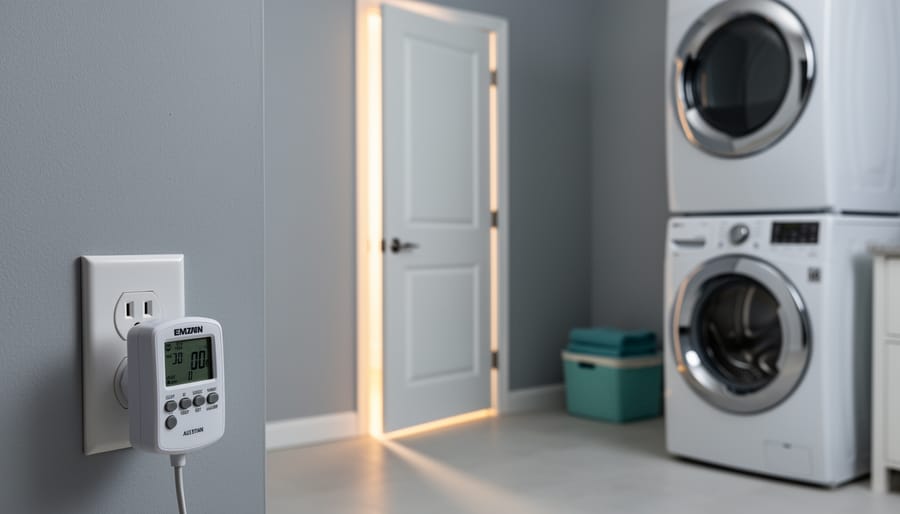
Why Is There a Quiet Energy Drain Behind the Laundry Room Door? Causes and How to Fix It
Behind that closed laundry room door, your washing machine and dryer are likely drawing 3 to 15 watts each around the clock, even when idle. This phantom load from electronic control boards, display panels, and increasingly common Wi-Fi connectivity modules costs most households $15 to $45 annually per appliance, yet remains invisible to homeowners until a comprehensive energy audit reveals the culprit, as dryerventcleaningspringhill.com professionals frequently discover during routine maintenance inspections.
The quickest diagnostic? Use a plug-in power meter (available for under $25) to measure baseline consumption when both appliances are off but still plugged in. Readings above 5 watts per unit signal that standby electronics are draining more energy than necessary. Modern laundry appliances rely on always-on microprocessors to retain cycle settings, maintain clock displays, and enable remote start features through smartphone apps. While convenient, these systems create continuous draw that compounds across multiple rooms and can offset as much as 8 to 12 percent of the energy savings from a residential solar installation.
For solar consumers and energy professionals tracking whole-home efficiency, laundry room phantom loads represent a measurable gap in performance optimization. Maintenance extends beyond mechanical components to include power management. This guide delivers structured diagnostics, quantifies root causes specific to 2026 appliance architectures, and presents a tiered remediation sequence from simple outlet timers to smart panel integration. DIY homeowners will find step-by-step measurement protocols, while renewable energy installers gain actionable strategies to maximize solar-plus-storage ROI by eliminating unnecessary baseload consumption across client properties.
Recognizing the Symptoms: Is Your Laundry Room Wasting Energy?
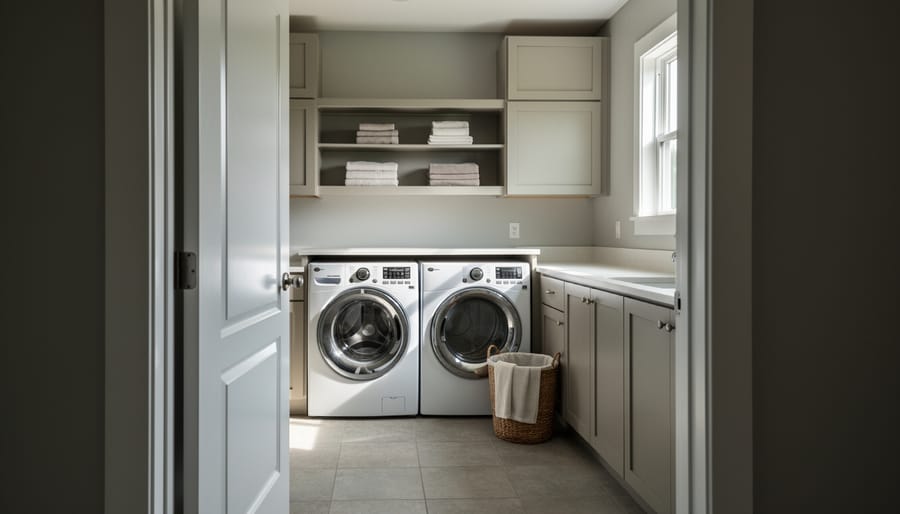
Most homeowners never suspect their laundry appliances are consuming electricity around the clock, yet several telltale signs reveal this hidden drain. Start with your utility bill: if your baseline consumption, the power draw when no major appliances are running, has crept upward without explanation, laundry room standby loads may be the culprit. A household with a modern washer and dryer can see baseline increases of 50 to 150 kWh annually from phantom loads alone.
Physical inspection offers immediate clues. Walk into your laundry room late at night or when you haven’t run a load in days. Touch the control panel of your washer or dryer, if it feels warm to the touch, internal circuits are drawing power continuously. Check whether digital displays remain illuminated 24/7, showing the time, cycle options, or status indicators even when the appliance sits idle. These glowing screens, while convenient, signal that the machine never truly powers down.
- Unexplained 5-15% increase in monthly baseline electricity consumption
- Appliance control panels warm to the touch when not in use
- LED or LCD displays that never turn off, even after extended idle periods
- Wi-Fi indicator lights showing constant connectivity status
- Smart meter data revealing consistent 5-20 watt draw from laundry circuits during overnight hours
For households with smart meters or whole-home energy monitors, review your consumption graphs during periods when you know no loads were active. A flat, persistent draw of five to twenty watts from your laundry room circuit, especially between midnight and 6 a.m., confirms standby power waste. Typical phantom loads for laundry equipment range from eight to fifteen watts per appliance, totaling 70 to 130 kWh per year for a washer-dryer pair. That translates to $10 to $20 in avoidable annual costs, depending on your electricity rate, and represents pure inefficiency before you’ve washed a single garment.
Primary Causes of Standby Energy Consumption in Laundry Appliances
Electronic Control Systems and Digital Displays
Modern washing machines and dryers rely on sophisticated electronic control systems that never truly sleep. Unlike mechanical dial timers from decades past, today’s touchscreen panels and LED displays stay powered around the clock to maintain their digital intelligence.
The microprocessor control board sits at the heart of every contemporary laundry appliance, drawing 1-5 watts continuously even when the machine appears off. This persistent power keeps the internal clock synchronized, preserves your saved cycle preferences, and ensures the control panel lights up instantly when you approach. Without this standby current, you’d need to reprogram settings after every use and wait for the system to boot up like an old computer.
Digital displays present the largest drain within this category. A full-color touchscreen can pull 3-4 watts alone, while simpler LED panels typically consume 1-2 watts. The backlight circuitry, touch-sensitive layer, and display driver chips all require steady voltage to remain responsive. Many appliances keep status lights illuminated 24/7, signaling cycle completion or filter maintenance long after you’ve left the room.
This continuous draw adds up: a washer and dryer pair consuming 3 watts each wastes 52 kilowatt-hours annually, costing $6-8 depending on your electricity rate. The convenience of instant-on controls comes with a measurable energy price tag.
Wi-Fi and Smart Connectivity Modules
Smart washers and dryers marketed with Wi-Fi connectivity maintain constant communication with your home network, creating a measurable energy drain even when the appliances sit idle. The wireless module inside each connected appliance typically draws 3-8 watts continuously to support remote monitoring through manufacturer apps, voice assistant integration, and push notifications about cycle completion or maintenance alerts.
This always-on connectivity requirement means a smart washer-dryer pair can consume 50-140 kWh annually just to stay connected, equivalent to running a modern refrigerator for two weeks. The energy penalty stems from the radio chipset, network processor, and associated circuitry that must remain powered to respond instantly when you send a remote start command or check cycle status from your phone.
Models with multiple wireless protocols suffer higher draws: a dryer supporting both Wi-Fi and Bluetooth simultaneously may pull 6-8 watts in standby, while simpler Wi-Fi-only implementations hover around 3-4 watts. If you rarely use remote features, disabling wireless connectivity through the appliance settings menu typically reduces standby consumption by 60-75 percent, cutting your laundry room’s baseline power draw without sacrificing core washing and drying functions.
Internal Transformers and Power Supplies
Modern laundry appliances rely on internal transformers and switching power supplies to convert standard household voltage (120V or 240V) into the low-voltage DC power required by electronic control boards, sensors, and display panels. These conversion circuits typically remain energized around the clock, ready to respond instantly when you press a button or open the door.
The problem lies in transformer efficiency. Older linear transformers, common in washers and dryers manufactured before 2015, can draw 3-7 watts continuously even when the appliance sits idle. This wasted energy dissipates as heat, you might notice warmth near control panels or back panels where power supplies are located. Inefficient designs lose 20-40% of input power during voltage conversion.
Newer switching-mode power supplies (SMPS) operate more efficiently, wasting only 0.5-2 watts in standby. However, many laundry rooms still contain decade-old appliances with thirsty transformers running 24/7. Over a year, a single inefficient transformer can waste 50-60 kWh, costing $8-15 depending on your electricity rate.
Transformer losses compound when both washer and dryer remain plugged in constantly, creating a persistent baseload that solar systems must accommodate and battery storage cannot avoid.
Auxiliary Equipment: Water Heaters, Booster Pumps, and Gas Valves
Laundry room energy waste extends beyond washers and dryers to auxiliary equipment often overlooked in energy audits. Tankless water heaters dedicated to laundry circuits maintain internal electronics and frost protection circuits that draw 3-10 watts continuously, accumulating 26-88 kWh annually even when no hot water flows. Hot water recirculation pumps cycle periodically to keep supply lines warm, consuming 50-150 watts during operation, potentially 300-600 kWh per year if poorly programmed.
Gas dryers with standing pilot lights burn continuously regardless of use, wasting equivalent energy of 300-600 kWh annually through constant combustion. Modern electronic ignition systems eliminate flame waste but require transformer circuits drawing 2-4 watts in standby mode. Tankless units serving laundry sinks add similar parasitic loads.
Water softeners and booster pumps for high-efficiency washers contribute another 5-15 watts each when idle but energized. Identify these secondary loads by temporarily disconnecting circuits during multi-day measurement periods. Recirculation pumps benefit most from timer controls limiting operation to laundry schedules, while tankless heater settings should disable unnecessary preheat functions.
Step-by-Step Solutions to Eliminate Laundry Room Energy Waste
Step 1: Measure Your Baseline Consumption
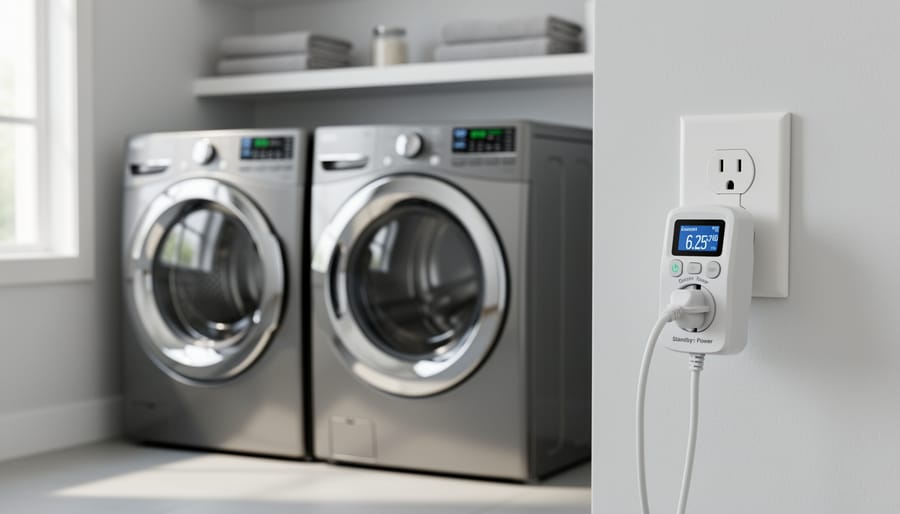
Before implementing any fixes, you need hard data on what your laundry appliances actually consume in standby mode. Plug a kill-a-watt meter or similar energy monitor into the outlet between your washer and the wall socket. Let it record for 24 hours while the machine sits idle, no wash cycles, just normal standby. The meter will display cumulative kilowatt-hours and instantaneous wattage, typically revealing 2-8 watts of continuous draw from control boards, displays, and Wi-Fi modules.
For 240-volt dryers, standard plug-in meters won’t work. You’ll need a whole-circuit monitor that clamps around the breaker wires in your electrical panel, such as models from Emporia or Sense. These track real-time consumption and log baseline patterns through smartphone apps, isolating the dryer’s phantom load from active drying cycles.
Compare your measured standby draw against the appliance nameplate or Energy Guide label. Anything above 5 watts per appliance represents a prime target for reduction, that’s 44 kWh annually per unit, costing $5-15 depending on your local rates and justifying immediate intervention.
Step 2: Disable Unnecessary Smart Features
Most smart washers and dryers ship with every connectivity feature enabled by default, creating unnecessary standby draw when you rarely use remote monitoring or app control. Disabling these features can cut phantom loads by 40-60% without affecting core washing and drying performance.
Start by accessing your appliance’s settings menu. On touchscreen models, look for “Settings,” “Preferences,” or a gear icon. Older digital displays typically require holding specific button combinations, consult your manual or search “[brand] [model] disable Wi-Fi” online for exact sequences. LG front-loaders often use “Temp + Soil Level” held for three seconds, while Samsung models may require “Smart Control” plus “Pre Wash” simultaneously.
Disable Wi-Fi or Smart Connect first. This eliminates the largest single source of standby power, typically 3-5 watts continuously. If you occasionally use remote start, remember you can re-enable it temporarily through the same menu rather than leaving connectivity active permanently.
Turn off “Always On Display” or reduce display brightness to minimum. Some models offer an “Energy Saver Display” mode that darkens the screen after 60 seconds instead of maintaining full brightness indefinitely. This alone saves 1-2 watts on LED panel models.
Disable “Remote Start Enable” if you always begin cycles manually at the machine. This feature requires the appliance to monitor for incoming app commands continuously. Similarly, turn off “Delay Start Memory” unless you regularly schedule overnight cycles.
Trade-offs are minimal. You lose smartphone notifications when cycles complete and cannot start laundry remotely, conveniences most households use fewer than five times yearly while paying for constant connectivity. Voice assistant integration will also stop working. Core washing performance, cycle options, and manual controls remain completely unaffected.
Check settings persist after power interruptions. Some models revert to factory defaults if unplugged, requiring you to repeat this process after maintenance or outages.
Step 3: Install Advanced Power Strips or Smart Switches
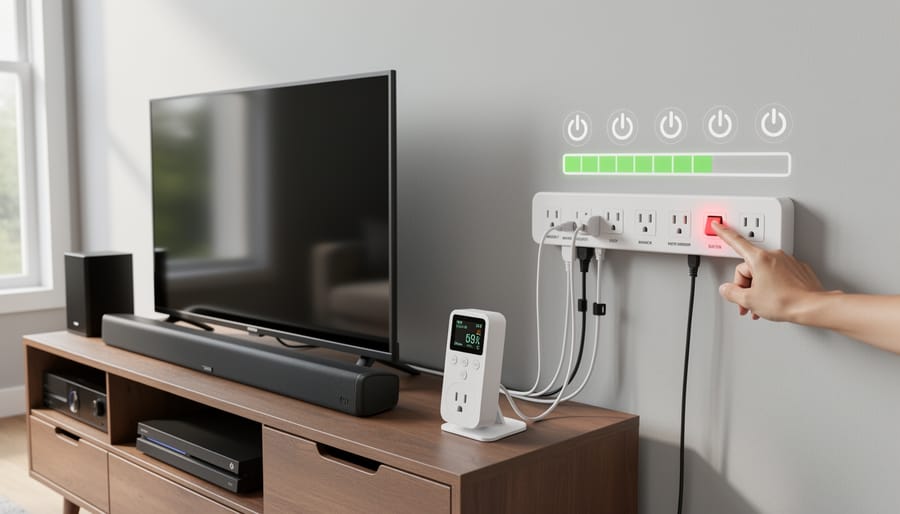
Installing hardware control solutions provides a reliable method to eliminate standby draw when measurement and settings adjustments prove insufficient. The choice between power strips, timer switches, and smart outlets depends on your laundry room’s electrical configuration and appliance voltage requirements.
For standard 120V washing machines, commercial-grade switched power strips offer the simplest implementation. Look for units rated 15A minimum with individual outlet switches and surge protection, models from Tripp Lite or CyberPower typically handle washer motor startup currents reliably. Position the strip where you can easily toggle power before leaving for work or vacation. Timer-based strips automate this process, cutting power during predetermined windows like overnight hours or weekday afternoons when laundry operations are unlikely.
Electric dryers operating on 240V circuits require different approaches. Standard power strips cannot handle the voltage or 30A current draw. Instead, install a manual disconnect switch in the dryer’s dedicated circuit, a straightforward task for licensed electricians that costs $150, $300 including materials and labor. Alternatively, 240V smart switches from manufacturers like Enerwave or Aeon Labs integrate with home automation platforms, enabling scheduled shutdowns or voice-activated control through systems already managing solar production or time-of-use rate optimization.
Verify all solutions carry UL or ETL safety certification for the intended voltage and amperage. Improper installation of high-voltage switching equipment presents fire hazards and code violations.
Step 4: Upgrade to Energy Star Most Efficient Models
When simpler fixes don’t cut standby power enough, replacement becomes the most effective long-term solution. Energy Star Most Efficient models set the benchmark: these units typically draw under 1 watt in standby mode, compared to 3-7 watts for standard appliances. Over a year, that gap translates to 17-52 kWh saved per appliance, $2, $6 annually at typical rates, multiplied across washer and dryer.
Check the Energy Star product database and filter for “Most Efficient” certification. Compare the standby power specification listed in technical sheets; anything above 1 watt should trigger reconsideration. Also evaluate integrated efficiency metrics: newer models often combine lower standby draw with reduced active energy use and water consumption, compounding savings.
Payback calculation matters. If your current washer draws 5 watts continuously and a replacement draws 0.8 watts, you’ll save roughly 37 kWh yearly. At $0.13/kWh, that’s $4.80 per year, meaning a $500 premium over a basic model takes 104 years to recover on standby savings alone. Factor in the full efficiency profile, utility rebates, and appliance lifespan to justify the upgrade. Replacement makes financial sense when existing units near end-of-life or when total operating costs (active plus standby) show rapid payback.
Step 5: Integrate with Home Energy Management Systems
Home energy management systems (HEMS) offer the most sophisticated approach to laundry room efficiency, automatically scheduling circuits around favorable conditions. Modern platforms connect your washer and dryer to time-of-use pricing signals, activating loads during off-peak hours when electricity costs 40-60% less. For solar-equipped homes, HEMS can trigger laundry cycles during peak production windows (typically 10 AM to 2 PM), maximizing self-consumption and reducing grid dependence.
Systems like Sense, Emporia Vue, or Eaton’s Home Heartbeat integrate with smart panels to control individual 240V circuits, cutting power to laundry appliances during high-demand periods. Battery storage systems from Tesla, Enphase, or LG can be programmed to isolate phantom loads during grid outages, preserving capacity for critical functions.
Interoperability remains critical: prioritize devices supporting Matter, Zigbee, or OpenADR 2.0 standards for reliable cross-platform communication. Utility demand response programs may offer annual rebates of $25-75 for allowing automated load management during peak events, turning your laundry room into a grid asset rather than a constant drain.
Cost-Benefit Analysis: Quantifying Your Savings
Understanding the financial impact of laundry room standby power helps justify corrective action. A washing machine drawing 8 watts continuously consumes 70 kWh annually, while a smart dryer pulling 12 watts adds another 105 kWh. Combined with auxiliary equipment like always-on displays or booster pumps, a typical laundry room wastes between 44 and 131 kWh per year doing nothing.
At the national average residential rate of $0.15 per kWh, this translates to $6.60 to $19.65 in annual waste. Multiply that by the appliance lifespan, typically 10 to 15 years, and you’re looking at $66 to $295 in unnecessary energy costs per laundry room over the equipment’s life. For homeowners in high-cost electricity markets like California or Hawaii, where rates exceed $0.30 per kWh, those figures double.
| Appliance Type | Standby Draw (Watts) | Annual Waste (kWh) | Cost at $0.15/kWh | Recommended Solution |
|---|---|---|---|---|
| Front-load washer with Wi-Fi | 8 | 70 | $10.50 | Disable remote connectivity |
| Smart dryer with touchscreen | 12 | 105 | $15.75 | Install smart switch with schedule |
| Basic top-load washer | 3 | 26 | $3.90 | Advanced power strip |
| Gas dryer with electronic ignition | 5 | 44 | $6.60 | Timer-controlled outlet |
Intervention costs vary. Plug-in energy monitors run $20 to $40, advanced power strips cost $15 to $50, and smart switches range from $25 to $60 installed. Most solutions pay for themselves within two to four years through energy savings alone. Carbon footprint reduction adds another dimension: eliminating 100 kWh of phantom load prevents roughly 40 to 70 kg of CO2 emissions annually, depending on your grid’s generation mix. For solar homeowners, reducing baseload consumption maximizes self-consumption rates and improves battery storage efficiency, effectively extending your system’s financial return.
Prevention Strategies and Long-Term Best Practices
Sustained efficiency starts before you carry an appliance through the door. When shopping for a new washer or dryer, request standby power specifications from manufacturers or review third-party lab reports that measure idle consumption. Prioritize models certified to draw less than 1 watt in standby mode, a threshold established by international efficiency programs and increasingly adopted by leading brands. Many manufacturers now publish this data in extended specification sheets, even when EnergyGuide labels focus only on active operation costs.
Build routine energy audits into your home maintenance calendar. Quarterly checks with a plug-in meter take five minutes per appliance and reveal whether standby consumption has crept upward due to firmware bugs, failed components, or new features activated during automatic updates. Document baseline readings when appliances are first installed, then compare future measurements to detect abnormal increases that may warrant service calls or settings adjustments.
Firmware updates merit attention beyond security patches. Manufacturers occasionally release power management optimizations that reduce standby draw or introduce new sleep modes for smart connectivity modules. Enable automatic update notifications in your appliance apps, but review release notes before installing, some updates add features that increase baseline consumption unless you manually disable them.
Integrate laundry room efficiency into whole-home energy strategies. Link smart appliances to your home energy management system so they enter deep sleep modes during peak rate periods or when solar production drops. Participate in utility demand response programs that can remotely cycle non-essential loads, including laundry standby circuits, during grid stress events.
Regulatory momentum supports your efficiency goals. California’s Title 20 appliance standards now cap standby power for many product categories, and the IEC 62301 international testing protocol provides standardized measurement methods that enable accurate product comparisons. These frameworks pressure manufacturers to engineer lower baseline consumption into every design generation, meaning patience often rewards buyers with meaningfully better options just months later.
Frequently Asked Questions
Can I safely unplug my washer and dryer between uses?
Yes, it’s completely safe to unplug standard washers and dryers when not in use. However, you’ll lose any programmed settings, clock displays, and remote connectivity features until you plug them back in.
Will disconnecting power void my appliance warranty?
No. Simply unplugging an appliance or using a power switch does not void manufacturer warranties. Just avoid tampering with internal components or electrical connections, which would violate warranty terms.
How much does standby power actually cost per year?
A typical laundry room drawing 10 watts continuously consumes about 88 kWh annually. At the national average rate of $0.16 per kWh, that’s roughly $14 per year, modest per household but significant when scaled across millions of homes.
What’s the difference between standby and off-mode power?
Standby mode keeps features like displays, clocks, and network connections active for instant use, typically drawing 1-8 watts. Off-mode refers to power drawn when an appliance is switched off but still plugged in, usually under 0.5 watts in compliant modern models.
Do gas dryers have phantom loads?
Yes. While gas dryers use natural gas or propane for heat, they still require electricity for the motor, drum rotation, control panel, and electronic ignition systems. Expect 2-5 watts of standby draw for displays and smart features.
These questions reflect real concerns from homeowners conducting energy audits and professionals optimizing renewable energy systems. Understanding warranty protections gives users confidence to implement power-cutting solutions without risk. The cost figures help justify intervention, especially for clients tracking solar news and grid-scale efficiency initiatives where aggregated phantom loads impact system sizing and storage capacity planning. Gas dryer clarification is particularly valuable since many assume gas appliances eliminate all electrical consumption, a misconception that leads to incomplete energy accounting in whole-home audits.
Key Takeaways for Energy Professionals
For installers conducting residential energy assessments, laundry room baseload must be measured separately from cycling loads. Use circuit-level monitoring or appliance-specific meters to isolate the 24/7 draw from electronic controls, Wi-Fi modules, and transformers. This granular data prevents oversizing battery systems by distinguishing true standby consumption from projected usage patterns. When designing solar-plus-storage systems, account for phantom loads in your minimum battery capacity calculations, a household with 50 watts of total standby draw requires an additional 1.2 kWh daily just to cover idle consumption.
Auditors should document specific appliance models and their standby specifications in baseline reports. Compare client equipment against Energy Star Most Efficient benchmarks (under 1 watt standby) to identify upgrade opportunities with measurable payback periods. During walkthroughs, demonstrate how disabling unnecessary connectivity features can reduce consumption by 60-80% without sacrificing core functionality.
System designers integrating energy storage online monitoring platforms should configure laundry circuits for automated demand management. Schedule high-draw wash and dry cycles during peak solar production windows, and use smart switches to cut phantom loads during off-peak periods when battery reserves are prioritized for critical loads.
In new construction and deep retrofit projects, specify appliances with documented standby power under 0.5 watts and advocate for whole-home energy management systems that provide real-time visibility into laundry room consumption. This proactive approach reduces lifetime operating costs and maximizes renewable energy utilization rates across the building envelope.
Addressing the quiet energy drain behind the laundry room door represents more than trimming a few dollars from your monthly utility bill. When multiplied across millions of households, eliminating 5-15 watts of continuous standby consumption reduces grid baseload demand by hundreds of megawatts, equivalent to the output of multiple power plants. For homeowners with solar arrays or battery storage systems, controlling phantom loads maximizes self-consumption ratios and extends backup runtime during outages. These gains compound as more appliances adopt ultra-low standby specifications and integrate with real-time energy management platforms.
The laundry room audit you conduct this week directly supports broader grid modernization and renewable integration goals. Measuring your baseline, disabling unnecessary smart features, and installing switched outlets creates immediate savings while demonstrating demand for manufacturer accountability. As appliance standards tighten and connected home systems mature, early adopters drive market transformation that benefits all consumers.
Energy professionals should position laundry room optimization within comprehensive efficiency programs and sustainability investments. Educate clients on whole-home baseload impacts when sizing solar plus storage, and advocate for specification clauses requiring sub-1-watt standby in new construction projects.
The future of home energy management lies in granular circuit-level control coordinated with distributed generation and dynamic pricing signals. Your laundry room is where that future starts, measure, optimize, and share your results to accelerate the transition to truly intelligent, waste-free homes.
