



What Is Geothermal Energy (and How Is It Generated)?
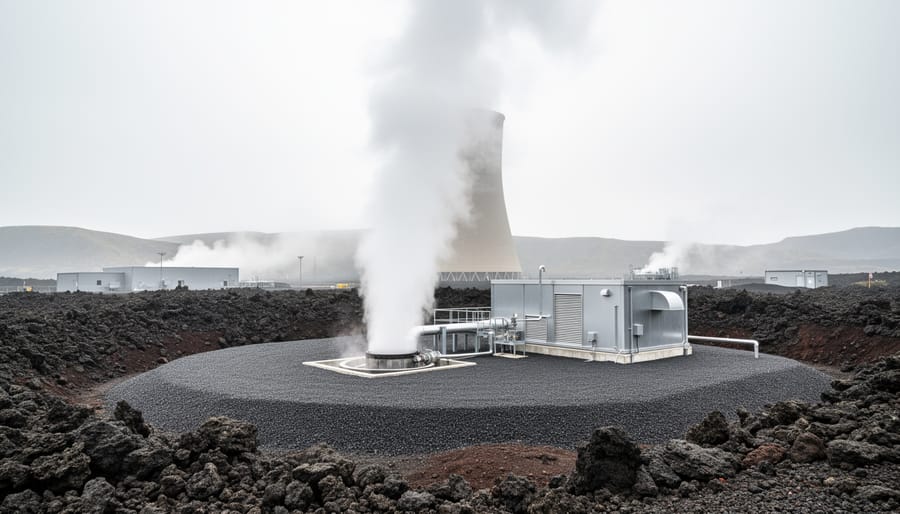
Geothermal energy is generated by extracting heat from Earth’s interior and converting it into electricity through steam turbines or binary-cycle systems. The process begins hundreds to thousands of meters below the surface, where naturally occurring heat reservoirs, heated by radioactive decay and residual formation energy, maintain temperatures ranging from 150°C to over 350°C. Wells drilled into these reservoirs bring hot water or steam to the surface, where power plants harness the thermal energy to drive generators.
This renewable baseload technology operates continuously, unlike solar or wind, making it a critical component of grid stability strategies in volcanically active regions and sedimentary basins with elevated geothermal gradients. As of 2026, global installed capacity exceeds 16 gigawatts, with significant expansion in Indonesia, Kenya, Turkey, and the United States. The generation process itself produces minimal greenhouse gas emissions compared to fossil fuels, though careful reservoir management prevents thermal depletion and induced seismicity.
Understanding the technical mechanics of geothermal generation requires examining three core elements: resource characteristics that determine viability, the engineering systems that extract and convert heat, and the operational parameters that sustain long-term production. The reliability of this understanding depends on rigorous fact-checking renewables data, particularly as emerging enhanced geothermal systems promise to expand viable development zones beyond conventional hydrothermal sites.
This technical explainer breaks down each stage of the generation workflow, from exploration and drilling through thermal conversion and grid integration, providing the detailed process knowledge professionals need to evaluate project feasibility and technology selection.
What Geothermal Energy Means
Geothermal energy is heat extracted from Earth’s interior and harnessed for power generation or direct thermal applications. Unlike fossil fuels burned to release stored chemical energy, geothermal systems tap into thermal energy that already exists beneath the surface, originating from two primary sources: the radioactive decay of isotopes such as uranium-238, thorium-232, and potassium-40 within Earth’s mantle and crust, and residual heat from the planet’s formation approximately 4.5 billion years ago. These processes continuously generate temperatures exceeding 5,000°C at Earth’s core, creating a vast thermal reservoir that conducts outward toward the surface.
This upward heat flow creates temperature gradients in the crust, typically increasing 25-30°C per kilometer of depth in most regions, though rates vary significantly based on local geology. Where tectonic activity, volcanic systems, or permeable rock formations allow, this heat accumulates in accessible reservoirs filled with water or steam. Geothermal energy generation exploits these natural concentrations by drilling wells to extract the thermal fluid, using its heat to drive turbines or supply buildings directly, then often reinjecting the cooled water to maintain reservoir pressure and sustain the resource.
- Geothermal gradient
- The rate at which temperature increases with depth underground, averaging 25-30°C per kilometer but varying by location based on crustal composition and tectonic setting.
- Hydrothermal resources
- Naturally occurring underground reservoirs of hot water or steam formed where permeable rock allows fluid circulation and heat accumulation, the most commonly exploited geothermal resource type.
- Hot dry rock
- Deep formations with high temperatures but insufficient natural permeability or water content, requiring engineered fracturing to create artificial reservoirs for heat extraction.
- Geopressured resources
- Deep sedimentary formations containing hot water under abnormally high pressure, often also carrying dissolved methane, offering combined thermal and chemical energy potential.
Geothermal energy qualifies as renewable because Earth’s internal heat regenerates continuously through ongoing radioactive decay and because extracted heat represents a tiny fraction of the planet’s total thermal content. Properly managed reservoirs can sustain production for decades without depletion.
How Geothermal Energy Generation Works
Heat Extraction Methods
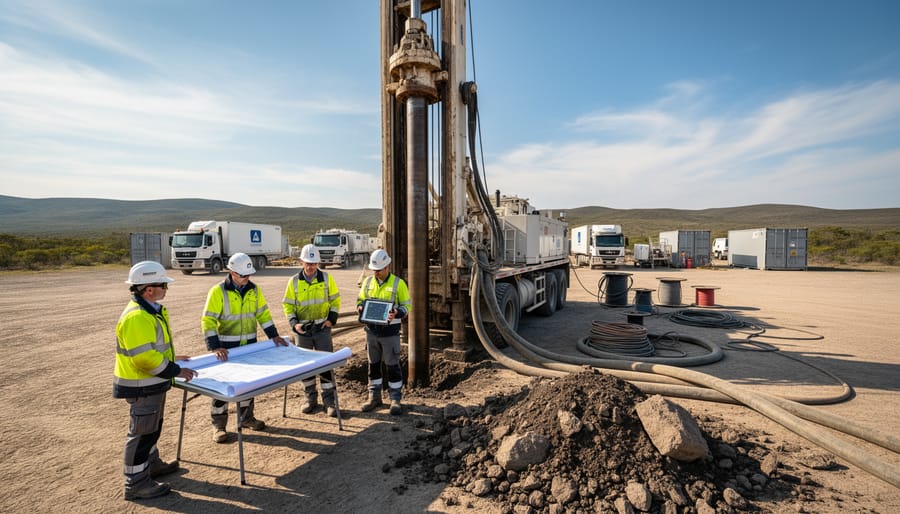
Heat extraction methods vary by resource type and geological conditions. In naturally permeable reservoirs with adequate fluid saturation, production wells tap into underground aquifers where water circulates through fractured rock at temperatures between 150°C and 370°C. These hydrothermal systems allow hot water or steam to flow to the surface under natural pressure or with assistance from downhole pumps.
Dry steam reservoirs, the rarest configuration, deliver vapour directly from underground fractures. The Geysers field in California exemplifies this approach, where steam at roughly 240°C rises through wells drilled 2,500 metres deep. Flash steam systems handle pressurized hot water that partially vaporizes as pressure drops during ascent, separating steam from liquid brine at the surface.
Enhanced geothermal systems represent a transformative technology for regions lacking natural permeability or fluid. Engineers drill into hot crystalline rock at depths exceeding 3,000 metres, then inject high-pressure water to fracture the formation and create reservoirs through stimulation. Cold water circulates through this engineered network, absorbing heat before extraction through a second well. While EGS projects currently represent less than 1% of operational capacity, they could unlock geothermal potential in non-volcanic regions where conventional methods aren’t viable. Fervo Energy’s Nevada demonstration achieved 3.5 megawatts in 2024 using horizontal drilling techniques adapted from oil and gas extraction, proving commercial feasibility at previously inaccessible sites.
Power Conversion Technologies
Once geothermal fluids reach the surface, the thermal energy they carry must be converted first into mechanical motion and then into electricity through integrated power systems. The conversion pathway depends on the fluid’s temperature and chemistry, but the fundamental principle remains consistent: heat drives a turbine that spins a generator.
In dry steam and flash steam configurations, pressurized water converts to steam either naturally or through controlled pressure reduction. This steam flows directly through turbine blades mounted on a shaft, causing rapid rotation that transfers kinetic energy to the generator’s magnetic coils, which produce electrical current through electromagnetic induction. The turbine stage extracts mechanical work from the steam’s thermal energy and pressure differential, while the generator stage completes the conversion to usable electricity. After passing through the turbine, spent steam enters condensers where cooling water returns it to liquid state, creating the pressure drop that sustains continuous flow through the system.
Binary cycle plants employ a fundamentally different approach suited to lower-temperature resources. Rather than using geothermal fluid directly, binary plants use secondary fluid with a much lower boiling point, such as isobutane or pentane, circulated through closed-loop heat exchangers. Hot geothermal brine transfers its thermal energy to this working fluid without direct contact, causing the secondary fluid to vaporize and drive a dedicated turbine-generator set. This separation protects equipment from corrosive minerals dissolved in geothermal water and enables efficient operation at temperatures as low as 57°C, expanding the geographic range of viable geothermal development. The cooled working fluid then condenses and recirculates through the heat exchanger in a continuous cycle.
Geothermal Power Plant Configurations
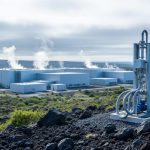
Geothermal power plants vary fundamentally in how they harness underground heat, with three distinct configurations designed for different reservoir characteristics. The choice of plant type depends primarily on the temperature and state of the geothermal fluid, ranging from superheated steam to moderate-temperature hot water.
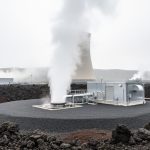
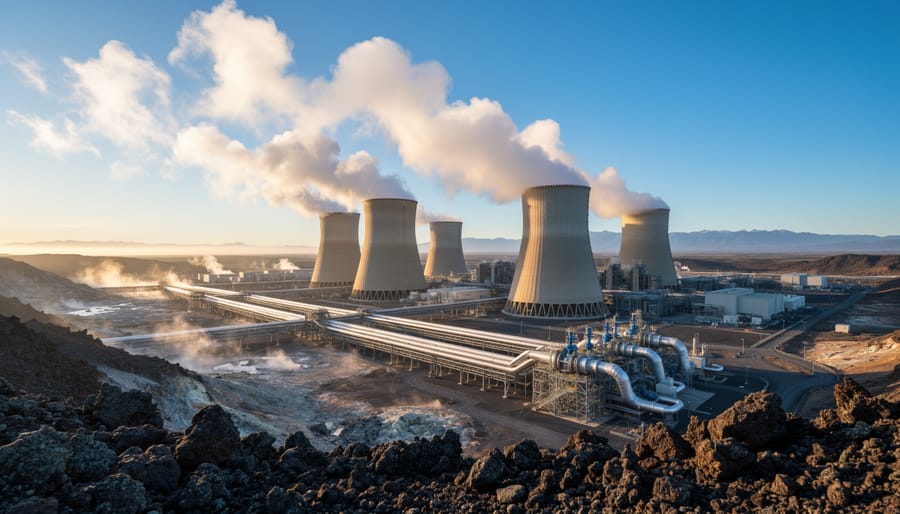
Dry steam plants represent the simplest and oldest geothermal technology, dating back to 1904 when Prince Piero Ginori Conti powered a small generator at Larderello, Italy. These facilities tap directly into underground steam reservoirs where temperatures exceed 235°C (455°F) and natural pressure keeps water in vapour form. The steam travels through pipes to the surface, passes through debris filters and moisture separators, then drives a turbine connected to a generator. After spinning the turbine, the steam condenses in cooling towers and most of the water returns to the reservoir through injection wells. Dry steam resources are geologically rare, occurring at fewer than 60 sites worldwide, primarily at The Geysers in California, Larderello in Italy, and Matsukawa in Japan. These plants achieve thermal efficiencies around 15-20% due to the direct energy transfer, but their scarcity limits broader deployment.
Flash steam plants dominate global geothermal electricity production, accounting for roughly 60% of installed capacity. They operate with high-temperature hydrothermal reservoirs where water temperatures reach 182°C (360°F) or higher but remain in liquid form under immense underground pressure. Production wells bring this superheated water to the surface, where it enters low-pressure separation tanks. The sudden pressure drop causes a portion of the water to vaporize instantly, a process called flashing. The resulting steam drives turbines while the remaining liquid either undergoes a second flash at even lower pressure in dual-flash configurations or returns to the reservoir. Single-flash plants typically operate with reservoir temperatures above 180°C, while double-flash systems can extract additional energy from fluids above 220°C, improving overall efficiency by 15-25%. These plants work best in tectonically active zones along plate boundaries and volcanic arcs, explaining their concentration in Indonesia, the Philippines, New Zealand, and Iceland.
Binary cycle plants expand geothermal’s geographic reach by working with moderate-temperature resources between 107°C and 182°C (225-360°F). Instead of using geothermal fluid directly, these systems pump hot water through heat exchangers where it transfers thermal energy to a secondary working fluid with a lower boiling point, typically isobutane, isopentane, or ammonia. This secondary fluid vaporizes, drives a turbine, condenses in a cooling system, and cycles continuously in a closed loop. The geothermal water never contacts the turbine and returns underground at nearly its original temperature, making binary plants effectively zero-emission facilities. They suit regions with lower geothermal gradients, including the Basin and Range Province in the western United States and parts of Germany’s Upper Rhine Graben. Their efficiency ranges from 10-13%, lower than flash systems, but they access far more abundant resources and produce reliable baseload power.
Where and How Geothermal Energy Is Used
Geothermal energy serves multiple applications across power generation, heating, and industrial processes, with deployment varying by resource temperature and regional energy needs. While electricity production dominates commercial geothermal development, direct-use applications harness lower-temperature resources for heating and cooling with significantly higher thermodynamic efficiency.
The power sector accounts for most installed geothermal capacity, with the United States (3.7 GW), Indonesia (2.4 GW), and the Philippines (1.9 GW) leading global deployment in 2026. These countries exploit high-temperature reservoirs primarily in volcanic arc settings. Iceland represents the most comprehensive geothermal utilization model, deriving 90% of its building heating and 30% of its electricity from geothermal sources, demonstrating the resource’s versatility in energy systems.
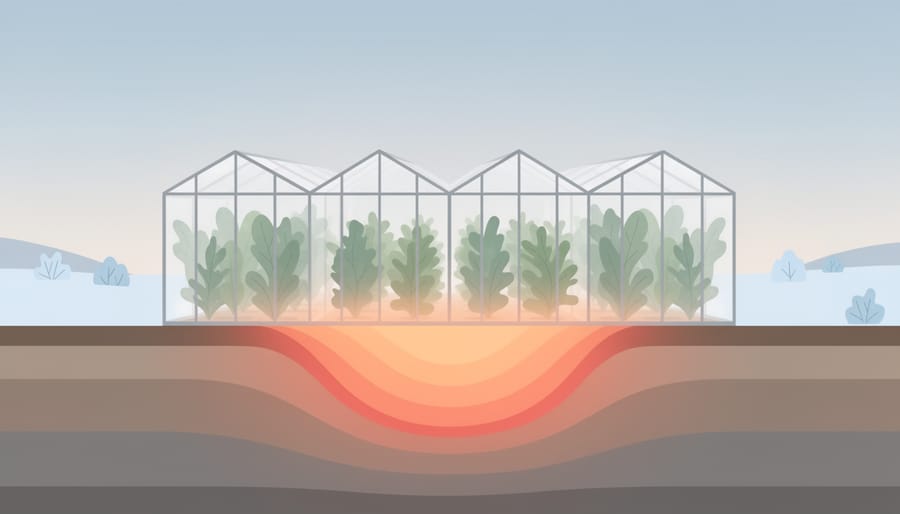
Direct-use applications operate at temperatures between 50°C and 150°C, requiring simpler infrastructure than power plants. District heating networks in Iceland, France, and Turkey distribute geothermal heat to thousands of buildings through insulated pipelines, eliminating combustion emissions from urban heating. In Boise, Idaho, the nation’s oldest geothermal district heating system has served downtown buildings since 1892. Greenhouse operations in the Netherlands, Kenya, and New Zealand use geothermal heat for year-round cultivation, reducing fossil fuel dependency for controlled-environment agriculture. Aquaculture facilities raising tilapia, prawns, and ornamental fish maintain optimal water temperatures with geothermal input, while industrial drying processes for timber, crops, and minerals benefit from consistent heat delivery.
Current geothermal applications span diverse sectors:
- Utility-scale and distributed power generation
- District heating networks for residential and commercial buildings
- Industrial drying operations for agriculture and manufacturing
- Greenhouse heating for extended growing seasons
- Spa and balneology facilities utilizing natural hot springs
- Ground-source heat pumps for building climate control
- Hydrogen production through high-temperature electrolysis
Ground-source heat pumps, technically distinct from conventional geothermal systems, exploit shallow ground temperatures (10-16°C at 3-10 meters depth) for space conditioning in any climate zone. These systems achieve heating coefficients of performance exceeding 3.5, delivering three to four units of thermal energy per unit of electricity consumed. Installation has expanded rapidly in China, Europe, and North America, with over 6 million units operating globally.
Emerging applications include geothermal desalination in water-scarce regions, where waste heat from binary cycle plants powers multi-effect distillation or membrane processes. Lithium extraction from geothermal brines in California’s Salton Sea and Chile’s Atacama Desert represents a developing nexus between renewable energy and critical mineral supply chains, recovering battery-grade lithium carbonate from fluids that would otherwise be reinjected without resource recovery.
Geothermal Resource Requirements and Site Selection
Successful geothermal development hinges on three interrelated geological characteristics: sufficient heat at accessible depths, permeable rock formations that allow fluid circulation, and an adequate water supply to transport thermal energy to the surface. These requirements explain why viable geothermal resources cluster in specific tectonic settings rather than distributing uniformly across the globe.
Heat flow, measured in milliwatts per square meter, varies dramatically depending on location. Plate boundaries, volcanic zones, and continental rift valleys exhibit heat flows exceeding 100 mW/m², compared to 50-60 mW/m² in stable continental interiors. In active tectonic regions, temperatures may reach 200-300°C at depths of just 2-3 kilometers, whereas similar temperatures in passive areas require drilling 6-8 kilometers down, making extraction economically unviable with current technology.
Permeability determines whether fluids can move through reservoir rocks at sufficient rates. Natural fracture networks, fault zones, and porous sedimentary formations provide the pathways needed for commercial-scale extraction. Enhanced geothermal systems attempt to engineer permeability in hot but impermeable rock through hydraulic stimulation, though this technology remains less proven than conventional hydrothermal exploitation.
Site selection begins with regional geological surveys mapping heat flow, tectonic structures, and volcanic features. Geochemical analysis of surface thermal springs reveals subsurface temperatures through chemical thermometry, analyzing dissolved mineral concentrations. Promising sites then undergo exploratory drilling, typically costing $3-5 million per well, to confirm reservoir temperature, permeability, and fluid chemistry. Current geothermal energy initiatives increasingly use magnetotelluric surveys and 3D seismic imaging to reduce exploration risk before committing to expensive test wells, improving success rates as industry participants and stakeholders seek better renewable news about project viability early in development cycles.
Common Questions About Geothermal Energy Generation
Geothermal energy raises practical questions for professionals evaluating its place in the renewable energy portfolio. Understanding the technology’s advantages, limitations and trade-offs helps inform deployment decisions and resource planning.
Is geothermal energy truly renewable?
Yes, geothermal qualifies as renewable because Earth’s heat regenerates faster than typical extraction rates, with continuous thermal flux from radioactive decay and residual planetary formation energy. Responsible reservoir management through water reinjection sustains production for decades without depleting the resource.
What’s the typical lifespan of a geothermal power plant?
Well-managed geothermal plants operate for 30 to 50 years, with some facilities exceeding 60 years through equipment upgrades and reservoir maintenance. The Geysers field in California has produced power continuously since 1960.
Can geothermal energy work anywhere?
No. Conventional geothermal requires specific geological conditions: high subsurface temperatures at accessible depths, adequate permeability, and fluid presence. Enhanced geothermal systems aim to expand viable locations by creating artificial reservoirs in hot dry rock.
How does geothermal compare to solar and wind power?
Geothermal delivers baseload power with capacity factors of 70 to 90 percent, eliminating the intermittency challenges of solar and wind. This makes it valuable for grid stability, though geographic constraints limit deployment compared to solar’s broader applicability.
What are the main environmental concerns with geothermal?
Potential issues include induced seismicity from reservoir stimulation, greenhouse gas emissions from dissolved CO₂ in geothermal fluids (still far lower than fossil fuels), water consumption in binary plants, and land subsidence if reservoirs aren’t properly managed. Closed-loop systems and careful site selection mitigate most risks.
Cost competitiveness remains project-specific. High upfront drilling and exploration expenses create financial risk, but once operational, geothermal plants benefit from minimal fuel costs and predictable output. Levelized cost typically ranges between five and nine cents per kilowatt-hour for conventional hydrothermal projects, making it competitive with other renewables in suitable locations.
Scalability faces real constraints. Only about seven percent of global land area has commercially viable geothermal resources with current technology. Enhanced geothermal systems could dramatically expand this footprint by accessing heat in non-hydrothermal settings, but technical challenges around drilling costs, fracture control and heat extraction efficiency need resolution before widespread deployment. Meeting editorial standards in reporting these developments requires distinguishing between laboratory results and field-proven performance at scale.
Geothermal energy generation demonstrates how mature extraction technologies can transform Earth’s continuous internal heat into reliable electricity and direct-use applications. Unlike intermittent renewables, geothermal plants operate as baseload power sources with capacity factors exceeding 90%, filling the reliability gap in decarbonized grids while producing minimal lifecycle emissions. The three plant configurations, dry steam, flash steam, and binary cycle, address different temperature regimes and geological settings, expanding the geographic reach of viable projects beyond traditional volcanic zones.
Enhanced geothermal systems promise to unlock vast untapped resources by creating artificial reservoirs in hot dry rock formations, potentially making geothermal viable across broader continental regions. As 2026 initiatives accelerate deployment through improved drilling techniques, advanced exploration methods, and supportive policies in markets from Indonesia to East Africa, geothermal’s contribution to the renewable energy mix continues growing. The technology’s proven track record in countries like Iceland and New Zealand, combined with innovations reducing capital costs and environmental footprints, positions geothermal as an essential component of global decarbonization strategies, a development covered extensively in renewable reporting worldwide.
